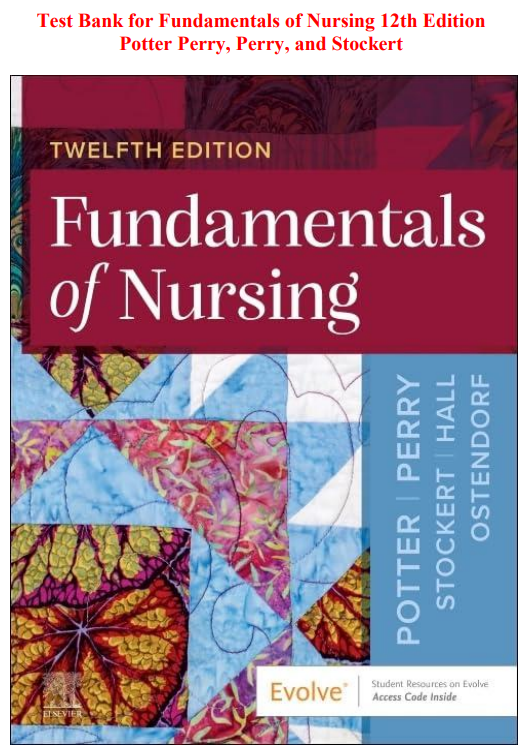
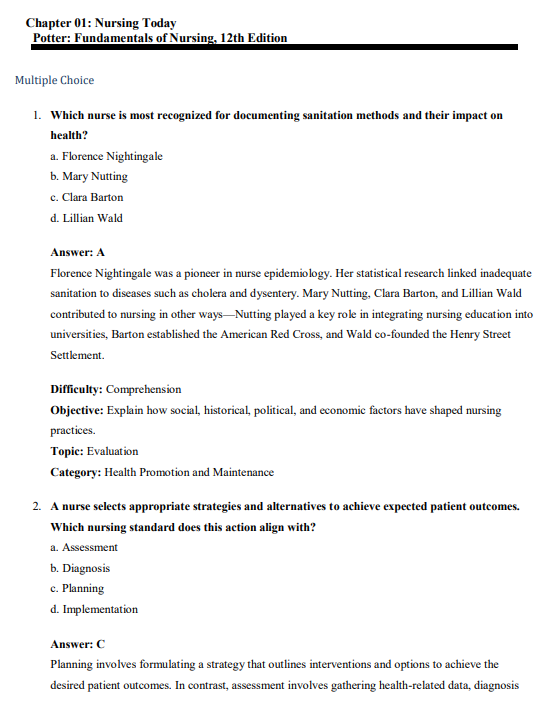
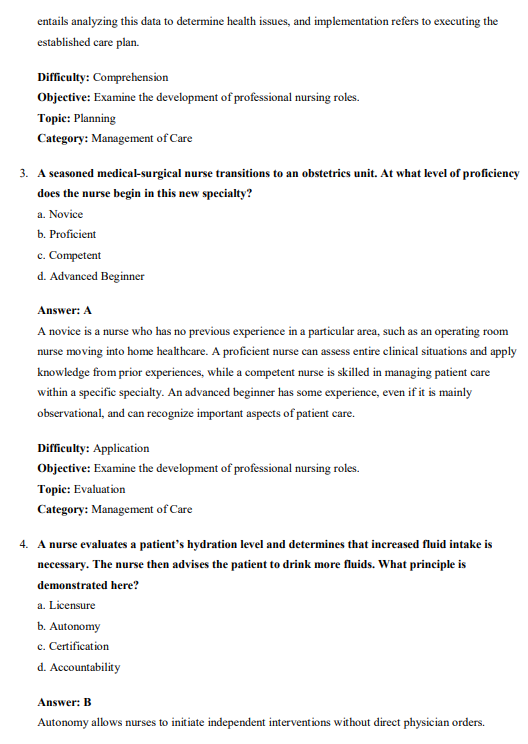
There is a reason Fundamentals of Nursing by Potter, Perry, and Stockert has remained one of the most widely used nursing textbooks in the world for decades. It does not just introduce nursing content. It builds nursing identity. It teaches students how to think about patients as whole people, how to apply the nursing process with discipline and compassion, how to act ethically under pressure, and how to deliver care that is both technically competent and deeply human. The 12th edition carries that legacy forward with updated evidence, expanded clinical reasoning content, and a stronger emphasis on patient safety, cultural competence, and interprofessional collaboration. This test bank was built to help you master every layer of that content.
Every question in this resource follows the 12th edition chapter structure. The coverage is exhaustive and carefully sequenced, beginning with the professional foundations of nursing including its history, theory, legal and ethical frameworks, and evidence-based practice principles. From there the content moves through the nursing process, critical thinking, clinical judgment, health assessment, infection prevention and control, medication safety, vital signs, diagnostic testing, patient communication and education, and the full range of fundamental nursing skills. Hygiene and comfort, oxygenation, circulation, fluid and electrolyte balance, nutrition, elimination, mobility and skin integrity, sleep, pain management, loss and grief, and perioperative nursing are all covered in depth. The resource also includes questions on lifespan considerations and the care of patients across diverse cultural, spiritual, and socioeconomic contexts, reflecting the full scope of what the 12th edition addresses.
What distinguishes this test bank from generic question collections is the quality and clinical grounding of its answer explanations. Every question presents a realistic patient scenario, identifies the correct answer, and follows it with a thorough rationale. These rationales do not simply restate which option is right. They explain the clinical, physiological, or ethical reasoning that makes the correct answer the best choice, walk through why each of the remaining options is incorrect, and connect the content to the nursing process or the NCLEX Next Generation framework wherever relevant. For students encountering the breadth of fundamental nursing content for the first time, and for those preparing for NCLEX where fundamental concepts are tested at every level of complexity, that depth of explanation is not supplementary. It is central to effective preparation.
The file is a fully searchable PDF. When you need to drill questions on infection control principles before a skills lab competency, review medication administration safety before your first clinical rotation, or consolidate your understanding of fluid and electrolyte imbalances before a unit examination, use Ctrl+F to navigate directly to that content in seconds. No time wasted scrolling through chapters you have already mastered. No disruption to your study momentum. Clean, direct, and efficient access to exactly the content you need at exactly the moment you need it.
Your download link is generated the moment your purchase is confirmed. No waiting period, no account creation, and no approval process. Open the file on your laptop, tablet, or phone and begin working through it immediately. The file is yours permanently. No subscription, no renewal fee, and no expiry date.
What You Get
- Full chapter coverage matched to the 12th edition layout
- Scenario-based multiple-choice questions grounded in the nursing process and clinical judgment framework
- Every question answered with the correct response clearly identified
- Detailed rationales explaining the clinical reasoning and addressing all answer options
- Searchable PDF format for fast, targeted review by topic, skill, or nursing concept
- One-time purchase with permanent, unlimited file access
Who This Is For
Pre-licensure nursing students in their first and second semesters of a BSN or ADN program will benefit most directly from this resource. It mirrors the content arc of the Potter, Perry, and Stockert textbook closely and is designed to support students as they build their foundational nursing knowledge from the ground up. It is also an excellent resource for students preparing for NCLEX, where fundamental nursing concepts are embedded in questions across every content category and every level of cognitive complexity. Practical nursing and LPN students whose programs use this textbook as a core reference will find it equally valuable. Nurses returning to practice after a career break who want a structured, comprehensive way to refresh their foundational knowledge before re-entering a clinical environment will also find this test bank a well-organized and clinically grounded study tool.
Sample Questions
Question 1
A nurse is caring for an 82-year-old patient admitted from a long-term care facility with dehydration and confusion. During the morning assessment, the patient attempts to climb over the side rail and states, “I need to go home right now.” The nurse knows that applying a physical restraint requires a provider order and informed consent. Before considering any restraint, which nursing action is the most appropriate first response?
A) Apply a vest restraint immediately to prevent the patient from falling while the nurse contacts the provider
B) Identify and address the underlying cause of the behavior by assessing for pain, urinary urgency, fear, or medication effects, and implement least-restrictive alternatives
C) Document the behavior and check on the patient every 30 minutes as part of hourly rounding
D) Ask the family to remain at the bedside continuously until the patient’s confusion resolves
Correct Answer: B
Detailed Explanation:
Physical restraints are among the most ethically and clinically complex interventions in nursing practice. Their use is associated with serious harm including pressure injuries, aspiration pneumonia, functional decline, psychological distress, and paradoxically an increased risk of falls and strangulation. Regulatory and professional standards require that restraints be used only as a last resort after all least-restrictive alternatives have been attempted and documented. Before any restraint is considered, the nurse is professionally obligated to identify the underlying cause of the behavior. In older adults with acute confusion, the behavior of attempting to leave or climb out of bed is frequently driven by treatable or addressable factors including unmet toileting needs, unrelieved pain, medication side effects such as those from benzodiazepines or anticholinergics, hypoxia, metabolic disturbances, fear, or disorientation from an unfamiliar environment.
Least-restrictive alternatives to explore before restraint include reorienting the patient calmly and frequently, involving familiar family members or caregivers, offering toileting, addressing pain, reducing environmental stimulation, using bed alarms, lowering the bed to its lowest position, and placing a mat beside the bed. Only after these measures have been tried and documented, and after obtaining a provider order and appropriate consent, may restraints be applied.
Option A is incorrect because applying a restraint immediately without a provider order, without attempting alternatives, and without consent violates legal, regulatory, and ethical standards of nursing practice regardless of the perceived safety benefit. Option C is incorrect because documenting and monitoring on a 30-minute interval does not address the immediate safety concern and represents an inadequate response to a patient who is actively attempting to leave the bed. Option D is incorrect because while family presence is a valuable and appropriate intervention that should be encouraged, placing the entire burden of continuous supervision on the family is not an appropriate nursing response and does not address the underlying cause of the patient’s behavior.
Question 2
A nurse is preparing to administer the following medications to a patient: metoprolol succinate 50 mg orally, lisinopril 10 mg orally, and furosemide 40 mg orally. Before administering these medications, the nurse assesses the patient’s vital signs and finds a blood pressure of 88/54 mmHg and a heart rate of 52 beats per minute. Which action reflects the safest and most appropriate nursing response?
A) Administer all three medications as ordered since the provider has reviewed the patient’s chart recently
B) Hold the furosemide only, administer the metoprolol and lisinopril, and document the blood pressure
C) Hold all three medications, reassess the patient fully, notify the provider of the vital sign findings, and await further orders before proceeding
D) Administer the furosemide as ordered and hold the metoprolol and lisinopril until the blood pressure improves
Correct Answer: C
Detailed Explanation:
Safe medication administration requires the nurse to go beyond the mechanical act of giving the right drug at the right dose. It requires clinical judgment about whether administering a prescribed medication is appropriate given the patient’s current physiological status. In this scenario, all three medications present serious safety concerns given the vital sign findings.
Metoprolol succinate is a beta-1 selective adrenergic blocker used for hypertension, heart failure, and dysrhythmias. Its primary cardiac effects include reducing heart rate and contractility. Administering it to a patient with a heart rate of 52 beats per minute risks worsening the bradycardia and compromising cardiac output. Standard practice is to hold beta blockers when the heart rate is below 60 beats per minute in adults and notify the provider.
Lisinopril is an ACE inhibitor that lowers blood pressure through vasodilation and reduced aldosterone secretion. Administering it to a patient with a blood pressure of 88/54 mmHg risks precipitating hemodynamic collapse. Furosemide is a loop diuretic that reduces blood volume through diuresis. In a patient who is already hypotensive, further reducing circulating volume with furosemide could cause a dangerous drop in perfusion pressure to vital organs including the kidneys and brain.
The appropriate nursing response is to hold all three medications, perform a thorough reassessment of the patient including level of consciousness, skin color and temperature, peripheral pulses, urine output, and symptom history, and immediately notify the provider of the findings. Administering any of these medications under these conditions without provider guidance represents a serious medication safety failure.
Options A, B, and D are all incorrect because they each involve administering one or more medications that are contraindicated given the current hemodynamic status of the patient. No combination of partial administration is appropriate here. The provider must be notified and new orders obtained before any of these medications are given.
Question 3
A nurse is performing a head-to-toe physical assessment on a newly admitted patient. During auscultation of the lungs, the nurse hears a low-pitched, coarse, rattling sound during both inspiration and expiration that partially clears after the patient coughs. How should the nurse document this finding, and what does it most likely indicate?
A) Fine crackles bilaterally, suggesting early pulmonary fibrosis or fluid in the alveoli
B) Rhonchi, suggesting secretion accumulation in the larger airways
C) Stridor, suggesting partial upper airway obstruction requiring immediate intervention
D) Pleural friction rub, suggesting inflammation of the pleural surfaces
Correct Answer: B
Detailed Explanation:
Accurate identification and documentation of adventitious breath sounds is a core fundamental nursing assessment skill with direct implications for clinical decision-making. The sound described in this question, low-pitched, coarse, rattling, present during both phases of the respiratory cycle, and partially clearing with coughing, is the definition of rhonchi. Rhonchi are produced by the movement of air through large airways, the trachea, mainstem bronchi, and lobar bronchi, that contain excess secretions or mucus. The turbulent airflow through these partially obstructed passages creates the characteristic low-pitched rumbling sound. The fact that the sound partially clears with coughing is a distinguishing clinical feature of rhonchi. When the patient coughs, secretions are mobilized and cleared from the large airways, reducing the obstruction and diminishing the sound. This feature helps differentiate rhonchi from other adventitious sounds that do not change with coughing.
The clinical implication of rhonchi is that the patient likely has retained secretions in the large airways, which may be due to conditions including chronic bronchitis, pneumonia, bronchiectasis, or simply an ineffective cough in a postoperative or debilitated patient. Nursing interventions directed at mobilizing and clearing secretions such as encouraging deep breathing and coughing, providing adequate hydration, repositioning, and in some cases chest physiotherapy may be indicated.
Option A is incorrect because fine crackles are high-pitched, discontinuous, non-musical sounds heard predominantly during late inspiration that do not clear with coughing. They suggest alveolar fluid or fibrosis, not large airway secretions. Option C is incorrect because stridor is a high-pitched, monophonic sound heard predominantly during inspiration and is loudest over the neck and trachea. It indicates significant upper airway narrowing and is a sign of potential airway emergency, not large airway secretions. Option D is incorrect because a pleural friction rub is a coarse, grating, leather-rubbing sound heard during both inspiration and expiration over the area of pleural inflammation, but it does not change with coughing because it originates from the movement of inflamed pleural surfaces against each other, not from airway secretions.
Question 4
A nurse is developing a care plan for a 68-year-old patient who has been on bed rest for four days following an acute myocardial infarction. The patient has no current skin breakdown but has multiple risk factors for pressure injury development. Which nursing intervention most directly addresses the primary pathophysiological mechanism responsible for pressure injury formation?
A) Apply a moisture barrier cream to the perineal area after each episode of incontinence
B) Reposition the patient every two hours and use a pressure-redistributing support surface
C) Encourage adequate protein and caloric intake to support tissue repair
D) Keep the head of the bed elevated at 30 degrees to prevent aspiration pneumonia
Correct Answer: B
Detailed Explanation:
Pressure injuries, previously called pressure ulcers or decubitus ulcers, develop primarily as a result of sustained mechanical pressure that compresses the soft tissues between a bony prominence and an external surface. This compression occludes the capillary blood flow to the overlying skin and underlying tissues, producing ischemia. When ischemia is sustained beyond the tissues’ tolerance threshold, cellular hypoxia and metabolic waste accumulation lead to cellular death and tissue necrosis. The primary pathophysiological mechanism driving pressure injury formation is therefore ischemia caused by unrelieved pressure.
The intervention that most directly addresses this mechanism is regular repositioning combined with a pressure-redistributing support surface. Repositioning every two hours relieves the compressive force on at-risk tissues before ischemia progresses to irreversible injury. Pressure-redistributing mattresses and overlays distribute body weight over a larger surface area, reducing the peak pressure at any single point and extending the safe interval between position changes. Together these two interventions target the root cause of pressure injury development.
Option A is incorrect because while moisture management is an important component of a comprehensive skin care program and moisture is a cofactor that softens and weakens skin integrity, it does not address the primary mechanism of ischemia from sustained pressure. Option C is incorrect because adequate nutrition, particularly protein and micronutrients such as vitamin C and zinc, supports tissue repair and immune function and is an important supporting intervention, but it does not directly prevent the ischemic cascade that initiates pressure injury formation. Option D is incorrect because elevating the head of the bed addresses aspiration risk, not pressure injury prevention. Furthermore, elevating the head of the bed above 30 degrees actually increases shear forces on the sacrum and coccyx, which is a recognized contributing factor to pressure injury development in that area.
Question 5
A nurse is preparing to perform a sterile urinary catheter insertion on a female patient. After opening the sterile catheterization kit and establishing the sterile field on the bedside table, the nurse turns to position the patient and accidentally touches the inner surface of the sterile drape with the sleeve of their scrub top. Which action reflects correct sterile technique?
A) Continue with the procedure because the contamination was minor and occurred at the edge of the sterile field
B) Discard the contaminated sterile field and supplies, obtain a new catheterization kit, and re-establish a clean sterile field before proceeding
C) Remove the contaminated drape, replace it with a clean paper towel, and proceed with the remaining sterile supplies
D) Wipe the contaminated area of the drape with an alcohol swab and allow it to dry before proceeding
Correct Answer: B
Detailed Explanation:
Sterile technique is grounded in a set of non-negotiable principles, the most fundamental of which is this: if in doubt, throw it out. Any item or surface that is part of a sterile field and comes into contact with a non-sterile surface or object is considered contaminated, regardless of how brief the contact was, how peripheral the location was, or how clean the non-sterile object appeared. This principle exists because sterility is an absolute state. A surface is either sterile or it is not. There is no concept of partial contamination or acceptable contamination in sterile technique, because even a single microorganism introduced into the urinary bladder through a catheter can initiate an infection.
In this scenario, the nurse’s scrub sleeve is a non-sterile surface. Contact between the scrub sleeve and the inner surface of the sterile drape has definitively contaminated that portion of the sterile field. Because the drape is the foundational surface on which all sterile supplies have been placed and from which sterile work will be conducted, contamination of the drape contaminates the entire sterile field. The correct and only appropriate response is to discard all contaminated supplies, obtain a new catheterization kit, and re-establish a sterile field from the beginning before proceeding with the procedure.
Option A is incorrect because the location of the contamination within the field does not determine whether contamination has occurred. All areas within the sterile field must remain sterile, including the edges and the drape surface itself. Option C is incorrect because a clean paper towel is not a sterile item and substituting it for the contaminated drape does not restore sterility to the field. Option D is incorrect because wiping a contaminated surface with alcohol does not restore sterility. Achieving sterility requires specialized processes such as autoclaving, ethylene oxide sterilization, or radiation, none of which can be replicated at the bedside.
FAQ
Is this an official publisher product?
No. This is an independently written study resource structured around the topics and chapter layout of the 12th edition. It is not affiliated with or endorsed by the authors or their publisher.
Will these questions match my nursing school exams or NCLEX questions?
This test bank is designed to build your foundational nursing knowledge and sharpen your clinical judgment so you are well prepared for any assessment format. It does not preview specific instructor exams or licensed board examination content.
What makes this test bank different from others?
The detailed rationales go well beyond identifying the correct answer. They explain the underlying nursing principle, address the clinical or physiological reasoning involved, and clarify why each incorrect option fails. That approach builds the kind of deep, durable understanding that performs under examination pressure and transfers into safe clinical practice.
What file format will I receive?
A fully searchable PDF, navigable by chapter, nursing concept, clinical skill, or keyword using any standard PDF reader on any device.
How quickly can I access the file after purchase?
Instantly. Your download link is generated immediately after checkout with no waiting period or additional steps required.
Can I open this on my phone or tablet?
Yes. The PDF opens cleanly on any iOS or Android device using a free PDF reader app with no formatting issues.
Do I need the textbook to use this?
Having the textbook alongside is helpful since the chapter order mirrors the 12th edition closely. The questions and rationales are also written in enough detail to be used independently for focused review and exam preparation.
Is there a subscription or renewal fee?
No. This is a one-time purchase. The file is yours to keep and use as many times as you need with no recurring charges or expiry date.

Lisa Horton –
Has to be one of the best test banks I have ever come across
Caleb Martins –
Perfectly designed for quick revision
Jarrod Bent –
Excellent!
Leo Fernandez –
Made studying much easier
Grace W. –
Great value for nursing learners