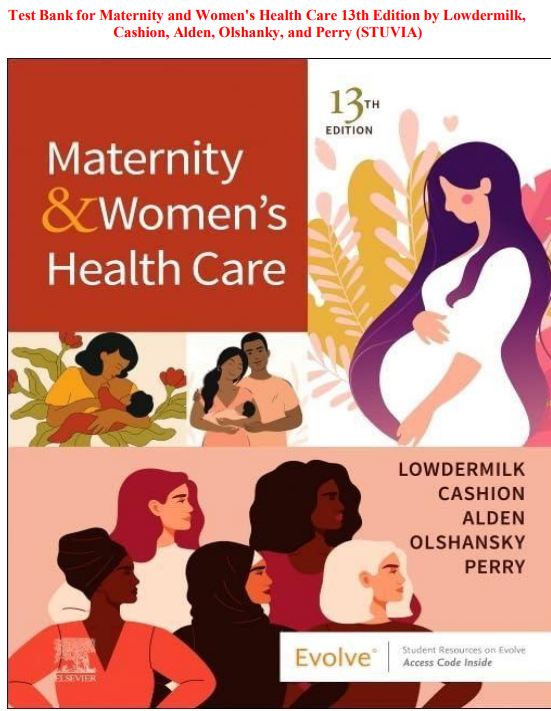
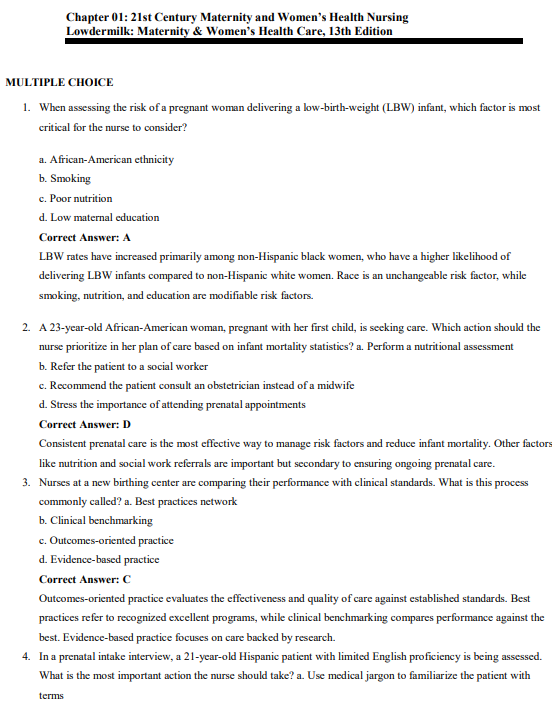
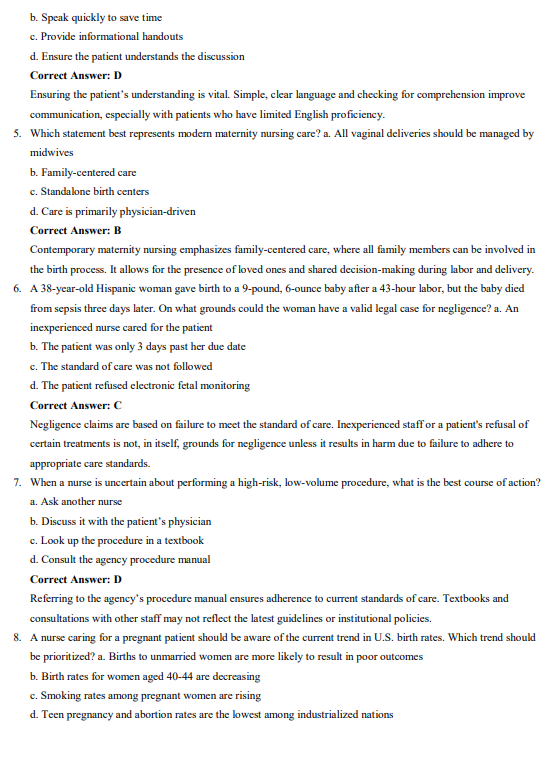
Women’s health nursing encompasses some of the most complex, emotionally significant, and clinically demanding experiences in all of healthcare. From the earliest stages of reproductive health through preconception counseling, the full arc of pregnancy, labor and delivery, postpartum recovery, newborn transition, and the management of gynecologic and reproductive disorders across the lifespan, the knowledge required of nurses working in this specialty is broad, deep, and constantly applied under conditions that leave no margin for error. The patients are often young, often frightened, and often navigating the most physically intense experiences of their lives. The families surrounding them carry hopes and anxieties that make every clinical decision feel weighty. Nurses who care for these patients carry an enormous responsibility, and they must be prepared to meet it fully. Reading the textbook is where preparation begins. This test bank is where it is sharpened.
Maternity and Women’s Health Care by Lowdermilk, Cashion, Alden, Olshansky, and Perry is one of the most trusted and comprehensive texts in women’s health nursing education. The 13th edition builds on decades of clinical and educational excellence with updated evidence-based content, expanded sections on reproductive justice and culturally responsive care, and a deeper emphasis on the clinical reasoning skills that nurses need to navigate the complexity of contemporary maternity and women’s health practice. It is a textbook that takes the full scope of women’s health seriously, and this test bank was written to match that standard.
Every question in this resource follows the 13th edition chapter structure. The coverage is thorough and carefully organized across the full breadth of the textbook. Questions address preconception and antepartum care, fetal development and nutrition, prenatal assessment and diagnostic testing, complications of pregnancy including gestational diabetes, hypertensive disorders, placental abnormalities, preterm labor, and multiple gestation. Labor and delivery content covers the physiology of labor, fetal monitoring and interpretation, pain management approaches, obstetric emergencies, and operative delivery. Postpartum content includes normal recovery, breastfeeding support, postpartum complications, and postpartum mood disorders. Newborn assessment and care content covers the transition to extrauterine life, newborn screening, common newborn conditions, and newborn nutrition. Women’s health content spans the full reproductive lifespan, including contraception, sexually transmitted infections, menstrual disorders, perimenopause and menopause, and gynecologic cancers. No major content area has been omitted.
What makes this test bank distinctly valuable is the quality of its answer explanations. Every question presents a realistic and clinically grounded scenario, clearly identifies the correct answer, and follows it with a thorough, well-reasoned rationale. These rationales do not simply restate what is right. They explain the physiological or clinical reasoning behind the correct choice, address why each of the remaining options fails, and where relevant connect the content to nursing priorities, safety principles, or the NCLEX clinical judgment framework. That level of explanation transforms each question from a test item into a genuine learning experience. You are not just checking whether you know the answer. You are building the understanding that makes the right answer clear under any examination or clinical conditions.
The file is a fully searchable PDF. When you need to focus your review on hypertensive disorders of pregnancy before a maternity examination, or consolidate your understanding of fetal heart rate pattern interpretation before a labor and delivery clinical rotation, use Ctrl+F to navigate directly to that content in seconds. No time lost scrolling through chapters you have already covered. No disruption to your study momentum. Direct, precise access to exactly the content you need at the moment you need it.
Your download link is generated the moment your purchase is confirmed. No waiting period, no account creation, no approval process standing between you and your study material. Open the file on your laptop, tablet, or phone and begin working through it immediately. The file is yours permanently. No subscription, no renewal fee, and no expiry date.
What You Get
- Full chapter coverage matched to the 13th edition layout across all maternity and women’s health content areas
- Clinically grounded scenario-based multiple-choice questions reflecting real practice complexity
- Every question answered with the correct response clearly identified
- Detailed rationales explaining the clinical reasoning and addressing all answer options
- Searchable PDF format for fast, targeted review by topic, complication, or care stage
- One-time purchase with permanent, unlimited file access
Who This Is For
Nursing students enrolled in maternity and women’s health nursing courses will benefit most directly from this resource. It mirrors the structure of the Lowdermilk et al. textbook closely and is designed to support students as they work through one of the most content-dense specialties in pre-licensure nursing education. It is also an excellent preparation tool for students approaching NCLEX, where maternity and women’s health content is consistently represented and where fetal monitoring, obstetric emergencies, and postpartum care are high-yield testing areas. RNs preparing for the Inpatient Obstetric Nursing certification examination will find the depth and clinical focus of this resource well matched to their preparation needs. Nurses transitioning into labor and delivery, postpartum, antepartum, or women’s health clinic settings will also find this test bank a structured and efficient way to consolidate the specialty knowledge they need before entering a new clinical environment.
Sample Questions
Question 1
A nurse is caring for a patient at 36 weeks of gestation who is admitted with a blood pressure of 158/104 mmHg on two separate readings 4 hours apart, severe headache, visual disturbances, and 3+ proteinuria on dipstick. The patient has no prior history of hypertension. Which condition does this presentation most likely represent, and which intervention is the highest priority?
A) Gestational hypertension; initiate oral antihypertensive therapy and schedule weekly biophysical profiles
B) Chronic hypertension with superimposed preeclampsia; prepare for induction of labor at 37 weeks
C) Preeclampsia with severe features; administer intravenous magnesium sulfate, initiate antihypertensive therapy, and prepare for delivery
D) HELLP syndrome; obtain a complete blood count and liver function tests before initiating any treatment
Correct Answer: C
Detailed Explanation:
The clinical presentation in this question meets the diagnostic criteria for preeclampsia with severe features. Preeclampsia is defined as new-onset hypertension after 20 weeks of gestation in a previously normotensive patient, combined with proteinuria or end-organ dysfunction. Severe features are present when any of the following occur: systolic blood pressure of 160 mmHg or higher or diastolic blood pressure of 110 mmHg or higher on two readings, severe headache unresponsive to medication, visual disturbances such as blurring or scotoma, right upper quadrant or epigastric pain, thrombocytopenia, impaired liver function, progressive renal insufficiency, or pulmonary edema. This patient has a blood pressure of 158/104 mmHg which is approaching severe range, along with severe headache and visual disturbances, both of which indicate cerebral involvement and significantly elevated risk of eclamptic seizure.
The immediate priority interventions are twofold. First, intravenous magnesium sulfate must be initiated for seizure prophylaxis. Magnesium sulfate reduces the risk of eclampsia by stabilizing neuronal membranes and reducing the excitability that drives seizure activity. Second, antihypertensive therapy must be initiated to bring the blood pressure into a safer range and prevent maternal stroke, which is the leading cause of death in women with severe preeclampsia. Labetalol, hydralazine, and nifedipine are the most commonly used agents. At 36 weeks of gestation with severe features present, delivery is the definitive treatment and preparations should begin immediately.
Option A is incorrect because gestational hypertension does not include proteinuria or neurological symptoms such as headache and visual changes. This presentation has moved beyond gestational hypertension into preeclampsia with severe features, requiring far more urgent intervention than oral antihypertensives and monitoring. Option B is incorrect because while chronic hypertension with superimposed preeclampsia is a valid diagnosis, the history here specifically states no prior hypertension, making new-onset preeclampsia the correct classification. The management strategy described in option B is also insufficiently urgent given the severe features present. Option D is incorrect because HELLP syndrome, which involves hemolysis, elevated liver enzymes, and low platelets, is a possibility that should be evaluated, but waiting for laboratory results before initiating magnesium sulfate and antihypertensive therapy in a patient with severe features is dangerous. Treatment must begin immediately based on clinical findings.
Question 2
A labor and delivery nurse is monitoring a patient who is 8 centimeters dilated and receiving an oxytocin infusion for augmentation of labor. The electronic fetal monitor shows a fetal heart rate baseline of 145 beats per minute with moderate variability. The nurse observes a pattern of decelerations that begin at the peak of each contraction, descend gradually, and return to baseline after the contraction has ended. The nadir of the deceleration consistently occurs after the peak of the contraction. How should the nurse interpret this pattern, and what is the priority nursing action?
A) Early decelerations caused by fetal head compression; continue monitoring and document the finding as a reassuring pattern
B) Variable decelerations caused by umbilical cord compression; perform a vaginal examination to check for cord prolapse and change the patient’s position
C) Late decelerations indicating uteroplacental insufficiency; discontinue the oxytocin infusion, reposition the patient, administer oxygen, increase IV fluids, and notify the provider
D) Accelerations reflecting fetal well-being; reassure the patient and continue the current plan of care
Correct Answer: C
Detailed Explanation:
The pattern described in this question is a textbook definition of late decelerations. Late decelerations are characterized by a gradual onset and gradual return, with the nadir of the deceleration occurring after the peak of the contraction and the return to baseline consistently delayed beyond the end of the contraction. This timing pattern distinguishes late decelerations from early decelerations, which mirror the contraction with the nadir occurring at the peak of the contraction, and from variable decelerations, which are abrupt in onset and variable in timing, shape, and duration.
Late decelerations are caused by uteroplacental insufficiency. During a uterine contraction, blood flow through the intervillous space of the placenta is temporarily reduced. In a well-functioning placenta with adequate reserve, this transient reduction in oxygen delivery does not compromise the fetus. However, when placental function is insufficient, the fetus cannot maintain adequate oxygenation during contractions, leading to a transient drop in the fetal heart rate as chemoreceptors detect hypoxemia and trigger a vagal response. The deceleration occurs after the contraction peak because it takes time for the hypoxemia to develop and for the reflex response to manifest.
The presence of late decelerations in a patient receiving oxytocin requires immediate intervention. The oxytocin infusion must be discontinued because it is driving the uterine contractions that are compressing the placenta and limiting fetal oxygenation. The patient should be repositioned to the left lateral position to relieve aortocaval compression and optimize placental blood flow. Supplemental oxygen should be administered to increase the oxygen available for placental transfer. IV fluid rate should be increased to improve maternal blood volume and placental perfusion. The provider must be notified immediately because persistent late decelerations may indicate fetal compromise requiring delivery.
Option A is incorrect because early decelerations are benign, mirror the contraction, and require no intervention. The pattern described does not fit early decelerations because the nadir occurs after the contraction peak, not at it. Option B is incorrect because variable decelerations are abrupt in onset and offset, vary in shape, and are caused by cord compression rather than placental insufficiency. The gradual, consistent, post-contraction timing pattern in this question is not characteristic of variable decelerations. Option D is incorrect because the pattern described is a deceleration, not an acceleration. Accelerations are transient increases in the fetal heart rate above baseline and are a sign of fetal well-being, not what is happening here.
Question 3
A nurse is assessing a postpartum patient who delivered vaginally 48 hours ago. The patient is breastfeeding and reports significant breast engorgement with pain rated at 7 out of 10 bilaterally. The breasts are hard, warm, and shiny. The nipples appear flattened. The patient reports that her infant is having difficulty latching and has been crying excessively since last evening. What is the most appropriate nursing intervention?
A) Advise the patient to temporarily discontinue breastfeeding and use formula until the engorgement resolves
B) Instruct the patient to apply ice packs to both breasts continuously until the swelling decreases before attempting to feed
C) Assist the patient with reverse pressure softening or gentle hand expression before feeds to soften the areola, apply warm compresses before nursing, and ensure correct latch positioning
D) Recommend that the patient pump both breasts to full emptiness before each feeding session to reduce engorgement
Correct Answer: C
Detailed Explanation:
Breast engorgement is one of the most common and uncomfortable postpartum breastfeeding challenges, typically occurring between 48 and 72 hours after delivery when milk production significantly increases. Engorgement occurs when blood flow and lymphatic fluid in the breast tissue increase dramatically alongside the hormonal shift that triggers milk production. The resulting swelling, firmness, and flattening of the nipple and areola create a major barrier to effective infant latch, which perpetuates a cycle where the infant cannot feed well, the breast is not adequately emptied, and engorgement worsens.
The most effective nursing interventions for engorgement target this cycle directly. Reverse pressure softening is a technique where gentle sustained pressure is applied around the base of the nipple to temporarily move some of the fluid away from the areola, softening it enough for the infant to achieve a proper latch. Gentle hand expression of a small amount of milk before feeding has the same effect. Warm compresses applied before nursing promote milk flow and make the breast tissue more pliable. Ensuring correct latch positioning is essential because a poor latch from an engorged breast further traumatizes the nipple and prevents effective milk removal. Cool compresses or chilled cabbage leaves applied after feedings can reduce inflammation and provide comfort.
Option A is incorrect because discontinuing breastfeeding is the worst possible response to engorgement. Cessation of nursing without gradual weaning leads to worsening engorgement, increased risk of mastitis, and loss of milk supply. It is not a recommended management strategy for engorgement in a patient who intends to breastfeed. Option B is incorrect because continuous ice application before feeding would cause vasoconstriction and impair milk letdown, making it harder, not easier, for the infant to feed. Brief cool compresses after feeding for comfort are appropriate but continuous pre-feed icing is counterproductive. Option D is incorrect because pumping to full emptiness before each feed removes the milk that the infant needs and signals the body to produce even more milk, worsening the engorgement over time. The goal is to soften the areola sufficiently for latch, not to empty the breast before the infant feeds.
Question 4
A 28-year-old patient presents to a women’s health clinic requesting contraception counseling. She has a history of migraine headaches with aura, hypertension managed with lisinopril, and a personal history of deep vein thrombosis following a prolonged period of immobility after a leg fracture two years ago. She is currently a non-smoker. She asks about combined oral contraceptive pills because her friend has had a positive experience with them. How should the nurse counsel this patient?
A) Combined oral contraceptive pills are an appropriate choice for this patient since she is a non-smoker and her medical conditions are all being managed
B) Combined oral contraceptive pills are contraindicated for this patient due to her history of migraine with aura, hypertension, and prior deep vein thrombosis, all of which significantly increase her risk of thromboembolic events and stroke
C) Combined oral contraceptive pills can be prescribed safely as long as the estrogen dose is kept low and the patient is monitored closely with quarterly blood pressure checks
D) Combined oral contraceptive pills are contraindicated only because of the prior deep vein thrombosis and are otherwise appropriate given her age and non-smoking status
Correct Answer: B
Detailed Explanation:
This question requires the application of contraceptive safety criteria to a patient with multiple medical conditions that interact significantly with estrogen-containing contraceptives. Combined oral contraceptive pills contain both estrogen and progestin. The estrogen component has prothrombotic effects, increasing the synthesis of clotting factors and reducing the activity of natural anticoagulants. In healthy women with no additional risk factors, this effect is clinically manageable. However, in women with underlying conditions that independently increase thromboembolic or cerebrovascular risk, the addition of exogenous estrogen can be dangerous or fatal.
This patient has three independent contraindications to estrogen-containing contraceptives according to the World Health Organization Medical Eligibility Criteria for Contraceptive Use, which classifies combined oral contraceptive pills as category 4, meaning unacceptable health risk, in each of these conditions. First, migraine with aura is associated with an increased baseline risk of ischemic stroke, and estrogen further amplifies that risk. Second, hypertension increases the risk of arterial thrombosis and stroke, and estrogen can raise blood pressure further. Third, a prior deep vein thrombosis indicates a personal history of venous thromboembolic disease, and estrogen significantly elevates the risk of recurrence. The presence of any one of these conditions alone would be sufficient reason to recommend against combined oral contraceptives. The presence of all three makes this a clear and unambiguous contraindication.
Appropriate alternative contraceptive options for this patient include progestin-only methods such as the progestin-only pill, the etonogestrel implant, or the levonorgestrel intrauterine device, none of which carry the same thromboembolic risk as combined estrogen-progestin methods.
Option A is incorrect because non-smoking status and controlled medical conditions do not eliminate the contraindications that estrogen poses in this patient’s specific clinical profile. Option C is incorrect because lowering the estrogen dose reduces but does not eliminate thromboembolic risk, and monitoring alone does not make the contraindication acceptable. Option D is incorrect because all three conditions independently contraindicate estrogen-containing contraceptives, not the prior DVT alone.
Question 5
A nurse is caring for a newborn who was delivered at 39 weeks of gestation and is now four hours old. During the assessment, the nurse notes the following findings: axillary temperature 36.1°C, heart rate 148 beats per minute, respiratory rate 68 breaths per minute, mild subcostal retractions, and nasal flaring. The infant’s skin color is pink centrally with mild acrocyanosis of the hands and feet. The infant was delivered by emergency cesarean section due to fetal distress following a prolonged second stage of labor. Which finding requires immediate provider notification?
A) Acrocyanosis of the hands and feet
B) Heart rate of 148 beats per minute
C) Respiratory rate of 68 breaths per minute with subcostal retractions and nasal flaring
D) Axillary temperature of 36.1°C
Correct Answer: C
Detailed Explanation:
Assessing the newborn in the immediate postnatal period requires careful distinction between findings that are normal components of the transition to extrauterine life and findings that represent pathological deviations requiring urgent evaluation. In this question, the respiratory findings are the critical concern.
The normal newborn respiratory rate ranges from 30 to 60 breaths per minute. A rate of 68 breaths per minute is above this range, placing this infant in the tachypneic category. More importantly, the presence of subcostal retractions and nasal flaring alongside the elevated respiratory rate indicates that the infant is working significantly harder than normal to breathe. Subcostal retractions occur when the diaphragm and accessory muscles of respiration contract forcefully to overcome increased airway resistance or decreased lung compliance, pulling the soft tissue beneath the rib cage inward with each breath. Nasal flaring is a compensatory mechanism to reduce upper airway resistance by widening the nares. Together these signs indicate respiratory distress, not the normal work of breathing.
In the context of this infant’s delivery history, emergency cesarean section following fetal distress and prolonged second stage of labor, the differential diagnosis for respiratory distress includes transient tachypnea of the newborn, meconium aspiration syndrome, pneumonia, and persistent pulmonary hypertension of the newborn. All of these require further evaluation and potential intervention. The provider must be notified immediately.
Option A is incorrect because acrocyanosis, cyanosis limited to the hands and feet, is a normal finding in newborns during the first 24 to 48 hours of life and reflects the immature peripheral circulatory system’s response to the temperature change at birth. It does not indicate hypoxemia and does not require intervention as long as central color is pink. Option B is incorrect because a heart rate of 148 beats per minute is within the normal neonatal range of 110 to 160 beats per minute and requires no urgent action. Option D is incorrect because while 36.1°C is at the low end of the normal axillary temperature range for newborns, which is 36.5 to 37.5°C, a single mildly low temperature reading in a four-hour-old newborn can be addressed through warming measures such as skin-to-skin contact or an incubator adjustment and does not represent the most urgent finding in this scenario. The respiratory distress signs are the priority concern.
FAQs
Is this an official publisher product?
No. This is an independently written study resource structured around the topics and chapter layout of the 13th edition. It is not affiliated with or endorsed by the authors or their publisher.
Will these questions match my course exams or NCLEX questions?
This test bank is designed to build deep clinical reasoning across the full scope of maternity and women’s health nursing so you are prepared for any examination format. It does not preview specific instructor exams or licensed board examination content.
What makes this test bank different from others?
The detailed rationales go well beyond identifying the correct answer. They explain the underlying physiology, connect clinical findings to disease mechanisms and nursing priorities, and clarify why each incorrect option fails. That approach builds the kind of deep, transferable understanding that holds up under examination pressure and translates directly into safe, confident clinical practice.
What file format will I receive?
A fully searchable PDF, navigable by chapter, clinical condition, care stage, or keyword using any standard PDF reader on any device.
How quickly can I access the file after purchase?
Instantly. Your download link is generated immediately after checkout with no waiting period or additional steps required.
Can I open this on my phone or tablet?
Yes. The PDF opens cleanly on any iOS or Android device using a free PDF reader app with no formatting issues.
Do I need the textbook to use this?
Having the textbook alongside is helpful since the chapter order mirrors the 13th edition closely. The questions and rationales are also written in enough detail to be used independently for focused review and examination preparation.
Is there a subscription or renewal fee?
No. This is a one-time purchase. The file is yours to keep and use as many times as you need with no recurring charges or expiry date.


Reviews
There are no reviews yet.