Pathophysiology is the class where everything finally clicks. It’s where anatomy and disease collide. You start to see why a symptom happens, not just what the symptom is. But that also makes it one of the hardest classes in a health science program. That’s why a solid practice tool matters so much.
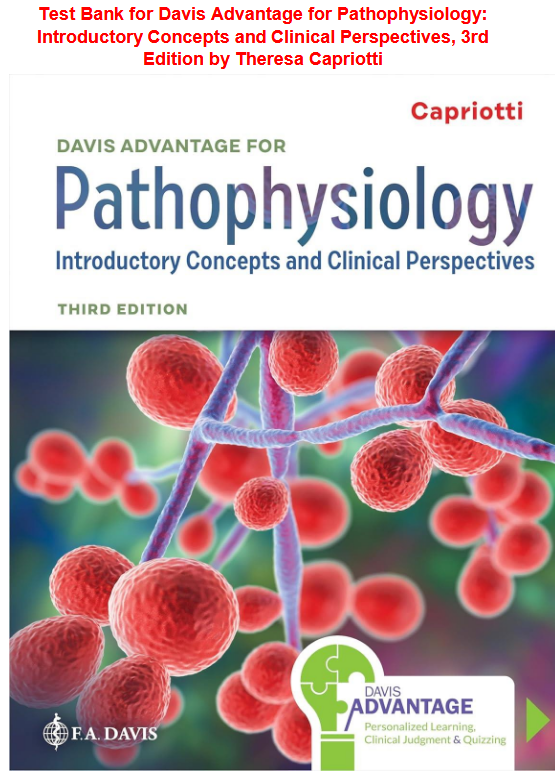
This test bank is built around the 3rd edition of Davis Advantage for Pathophysiology: Introductory Concepts and Clinical Perspectives by Theresa Capriotti. It follows the textbook chapter by chapter, so your practice sessions match what your instructor is actually teaching.
Whether you’re a nursing student, a PA student, or working through any allied health program that requires pathophysiology, this resource helps you connect disease processes to real clinical outcomes.
Table of Contents
I. The Cell
1. The Cell in Health and Illness
2. Cellular Injury, Adaptations, and Maladaptive Changes
3. Genetic Basis of Disease
II. Integrated Body Processes
4. Stress, Exercise, and Immobility
5. Obesity and Nutritional Imbalances
6. Pain
III. Fluid, Electrolyte, and Acid-Base Homeostasis
7. Fluid and Electrolyte Imbalances
8. Acid-Base Imbalances
IV. Infection and Inflammation
9. Inflammation and Dysfunctional Wound Healing
10. Infectious Diseases
11. Immune System Disorders
V. Hematologic Disorders
12. White Blood Cell Disorders
13. Red Blood Cell Disorders
14. Platelets, Hemostasis, and Coagulation Disorders
VI. Cardiovascular Disorders
15. Arterial Disorders
16. Ischemic Heart Disease and Conduction Disorders
17. Heart Failure
18. Valvular Heart Disease
19. Venous System Disorders
VII. Pulmonary Disorders
20. Respiratory Inflammation and Infection
21. Restrictive and Obstructive Pulmonary Disorders
VIII. Renal and Urological Disorders
22. Renal Disorders
23. Urological Disorders
IX. Hormonal and Reproductive Disorders
24. Endocrine Disorders
25. Diabetes Mellitus and the Metabolic Syndrome
26. Female Reproductive System Disorders
27. Male Reproductive System Disorders
28. Sexually Transmitted Infections
X. Gastrointestinal Disorders
29. Esophagus, Stomach, and Small Intestine Disorders
30. Large Intestine Disorders
31. Infection, Inflammation, and Cirrhosis of the Liver
32. Gallbladder, Pancreatic, and Bile Duct Dysfunction
XI. Neurological Disorders
33. Cerebrovascular Disorders
34. Chronic and Degenerative Neurological Disorders
35. Brain and Spinal Cord Injury
36. Psychobiology of Behavioral Disorders
XII. Musculoskeletal Disorders
37. Musculoskeletal Trauma
38. Degenerative Musculoskeletal System Disorders
39. Infection and Inflammatory Musculoskeletal Disorders
XIII. Cancer
40. Cancer
XIV. Integumentary Disorders
41. Skin Disorders
42. Burns
XV. Sensory Disorders
43. Eye Disorders
44. Ear Disorders
XVI. Aging and Multisystem Disorders
45. Pathophysiological Changes of Aging
46. SIRS, Sepsis, Shock, MODS, and Death
Why This Test Bank Works
1. It Matches the Textbook’s Structure
Every question is organized around the same units and chapters listed above. You won’t waste time sorting through irrelevant material.
2. It Focuses on Application, Not Just Recall
Pathophysiology exams rarely ask you to just define a term. They ask you to connect a mechanism to a symptom, or a symptom to a diagnosis. This test bank reflects that same clinical reasoning style.
3. Rationales Break Down the Reasoning
Every question includes an explanation of the correct answer and why the other choices don’t fit. This helps you understand disease mechanisms instead of just memorizing outcomes.
4. Plain Language, No Extra Fluff
Pathophysiology already comes with a heavy vocabulary load. This test bank keeps sentence structure simple so you can focus on the concept, not decode the wording.
5. Works With Any Study Schedule
Some students review one system a week. Others cram the weekend before finals. This test bank fits either approach without losing its structure.
Who This Test Bank Is For
- Nursing students taking a standalone pathophysiology course
- Physician assistant and pre-PA students
- Physical therapy and occupational therapy students
- Nurse practitioner students reviewing disease mechanisms
- Instructors building quizzes, exams, or homework sets
- Anyone reviewing pathophysiology before a certification exam
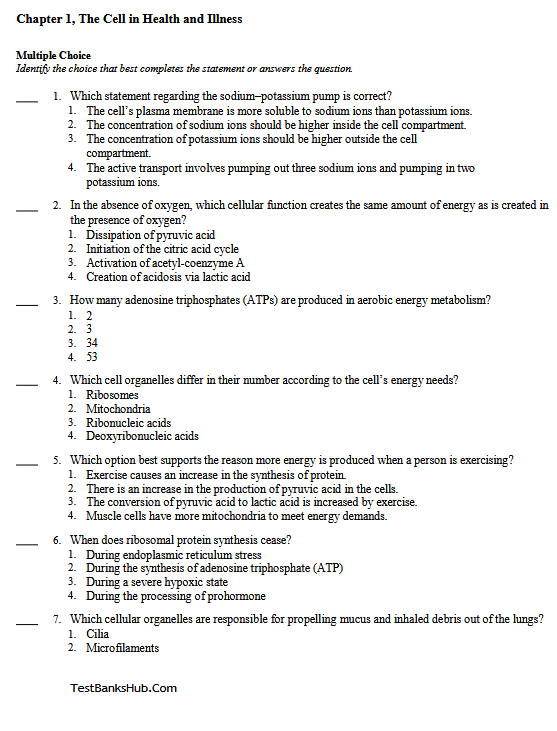
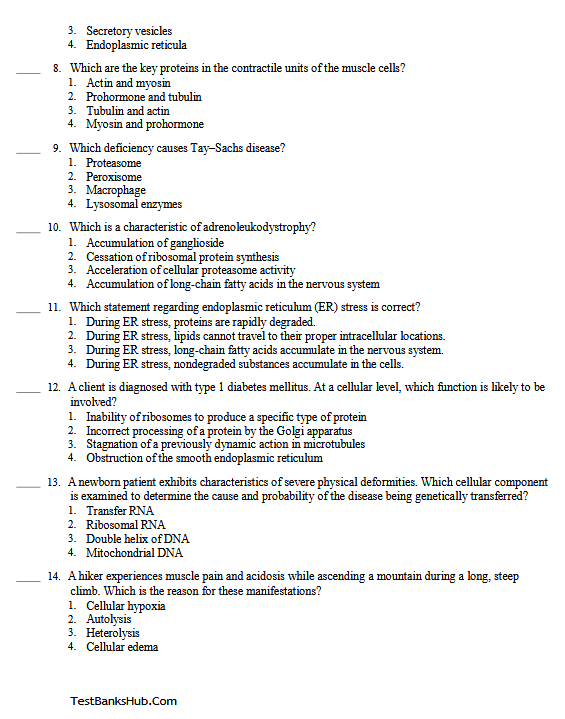
Sample Practice Questions
Here are five sample questions written in the same tone and difficulty as the full test bank. Use them to preview what the complete set looks like.
Question 1: Cellular Adaptation (Chapter 2)
A patient with chronic high blood pressure develops an enlarged heart due to increased workload. This type of cellular adaptation is known as what?
A) Atrophy
B) Hyperplasia
C) Hypertrophy
D) Metaplasia
Correct Answer: C) Hypertrophy
Rationale: Hypertrophy is an increase in cell size, often triggered by increased workload, as seen in the heart muscle under chronic high blood pressure. Atrophy is a decrease in cell size. Hyperplasia is an increase in cell number, not size. Metaplasia is the replacement of one cell type with another, which doesn’t apply to this scenario.
Question 2: Inflammation (Chapter 9)
Which of the following is a classic local sign of the acute inflammatory response?
A) Pallor
B) Decreased temperature at the site
C) Swelling
D) Reduced blood flow to the area
Correct Answer: C) Swelling
Rationale: Swelling, along with redness, heat, pain, and loss of function, is one of the five classic signs of acute inflammation. Increased blood flow and vessel permeability cause fluid to leak into tissue, producing swelling. Pallor, decreased temperature, and reduced blood flow are the opposite of what happens during an active inflammatory response.
Question 3: Acid-Base Imbalances (Chapter 8)
A patient with severe vomiting and diarrhea is at highest risk for developing which acid-base imbalance?
A) Respiratory acidosis
B) Respiratory alkalosis
C) Metabolic acidosis
D) Metabolic alkalosis
Correct Answer: C) Metabolic acidosis
Rationale: Severe diarrhea causes significant loss of bicarbonate from the gastrointestinal tract, which lowers blood pH and leads to metabolic acidosis. While prolonged vomiting alone can cause metabolic alkalosis from acid loss, the combination with severe diarrhea in this scenario shifts the greater risk toward metabolic acidosis due to bicarbonate loss. Respiratory acidosis and alkalosis both stem from changes in breathing pattern, not GI fluid loss.
Question 4: Cancer (Chapter 40)
Which characteristic is most typical of a malignant tumor compared to a benign tumor?
A) Slow, localized growth
B) Well-defined borders
C) Ability to invade surrounding tissue and metastasize
D) Encapsulation that prevents spread
Correct Answer: C) Ability to invade surrounding tissue and metastasize
Rationale: Malignant tumors grow aggressively, invade nearby tissue, and can spread to distant sites through the bloodstream or lymphatic system. Benign tumors typically grow slowly, stay localized, and often have well-defined, encapsulated borders that limit their spread. Those benign features are the opposite of what defines malignancy.
Question 5: Diabetes Mellitus (Chapter 25)
A patient with untreated type 1 diabetes develops rapid breathing, fruity-smelling breath, and confusion. These findings are most consistent with which condition?
A) Hypoglycemia
B) Diabetic ketoacidosis
C) Hyperosmolar hyperglycemic state
D) Somogyi effect
Correct Answer: B) Diabetic ketoacidosis
Rationale: Diabetic ketoacidosis develops when insulin deficiency forces the body to break down fat for energy, producing ketones that lower blood pH. This leads to rapid, deep breathing as the body tries to blow off excess carbon dioxide, along with the classic fruity breath odor from ketones. Hypoglycemia presents with shakiness and sweating rather than these findings. Hyperosmolar hyperglycemic state is more common in type 2 diabetes and typically lacks significant ketone production. The Somogyi effect refers to rebound hyperglycemia after nighttime hypoglycemia, not an acute presentation like this one.
These five questions are just a small sample. The complete test bank includes a much larger set of questions spanning all 46 chapters of the 3rd edition.
How to Study With This Test Bank
- Follow your course outline. Study units in the order your instructor assigns them.
- Read every rationale carefully. Pathophysiology is built on mechanisms, and the reasoning behind each answer matters more than the answer itself.
- Group related systems together. Cardiovascular and renal disorders often overlap, so reviewing them side by side helps concepts connect.
- Retest yourself after a few days. This strengthens recall better than reviewing the same material back to back.
- Use it as reinforcement, not a replacement. Pair this test bank with your assigned textbook readings for the best results.
Why This Beats Random Practice Quizzes
Generic pathophysiology quizzes online often use inconsistent terminology or skip topics your course actually covers. This test bank was built specifically around Capriotti’s 3rd edition, so the vocabulary, structure, and depth match what you’ll see on your real exams.
Format and Delivery
This test bank comes as a digital file. You get access immediately after purchase. No shipping. No waiting around. Study from your laptop, tablet, or phone whenever you have time.
Frequently Asked Questions
Is this test bank the same as the textbook?
No. This is a companion study resource. You’ll still need Davis Advantage for Pathophysiology: Introductory Concepts and Clinical Perspectives, 3rd Edition, for full explanations, images, and case studies.
Does this cover every body system?
Yes. Cardiovascular, respiratory, renal, endocrine, neurological, and every other major system covered in the textbook is represented.
Is this helpful for NCLEX or certification exam prep?
It can be. Pathophysiology concepts show up frequently on licensure and certification exams, so this practice helps reinforce that foundation.
Can instructors use this for building course exams?
Yes. Instructors and TAs often use test banks like this as a starting point for quizzes, midterms, or final exams.
What question types are included?
You’ll find multiple choice, true or false, matching, and short answer questions throughout the set.
Are rationales included for every question?
Yes. Each question comes with an explanation covering why the correct answer is right and why the other choices are incorrect.
Is this appropriate for PA or NP students?
Yes. Pathophysiology is a core course across nursing, PA, and NP programs, and this test bank was designed to support that broader audience.
How is this different from the chapter review questions in the textbook?
Textbook review questions are usually limited in number. This test bank offers a much larger, more comprehensive question set with detailed rationales for deeper practice.
Final Thoughts
Pathophysiology asks you to think like a clinician before you even reach clinicals. It’s about connecting the dots between cause and effect inside the human body. This test bank for the 3rd edition of Davis Advantage for Pathophysiology gives you a direct way to practice that thinking. Clear questions. Honest explanations. A study path built around the exact course you’re taking.
Grab your copy today and study with real confidence.
Winnie M. –
Great practice for test-taking skills
Morgan Fraiser –
Easy to navigate and study anywhere
Liam Mbogo –
Really handy during exam prep
Terence V. –
Helped reinforce what I learned
Peterson S. –
Helpful for practicing clinical judgment and critical thinking
Lucille Maria –
Helpful for practicing clinical judgment and critical thinking
Carol Kay –
Fantastic resource for nursing preparation
Lucas Gabriel –
A perfect study companion
Caleb Martins –
Helped me revise more efficiently
Rosemary R –
An excellent test bank
Mary Kesh –
Much better than I expected to receive.
Stephaniemclister –
Perfect
Theresa M. –
Excellent resource for reviewing key pathophysiology concepts
Leo Fernandez –
Questions closely resemble the exam material
Kamara Reid –
Excellent practice material with useful explanations.
Marcus R. –
Easy to use and very convenient
Helen Christie –
Great questions that closely match course topics
SHoustone –
Helpful explanations made reviewing much easier.
Jarrod Bent –
A useful tool for nursing exam preparation
Chloe Phillips –
Convenient practice resource for short study sessions.
Alexander Savic –
Good tool for revisiting concepts through repetition
Betty Morgot –
Helpful resource for maintaining steady revision progress
Dorcas M. –
Practice material makes studying more organized.
Tess Mwaure –
Good tool for reviewing course content.
Zakariah K. –
Helpful exercises for strengthening weak areas.
Alicia Silva –
Convenient resource for additional exam practice
Beryl A. –
Useful questions for improving topic mastery.