Some nursing exams test what you know. This one tests what you’d do. Prioritization and delegation questions ask you to think like a working nurse under pressure, deciding who needs attention first and what tasks can safely go to someone else. It’s a completely different mental muscle than memorizing lab values, and it takes real practice to build.
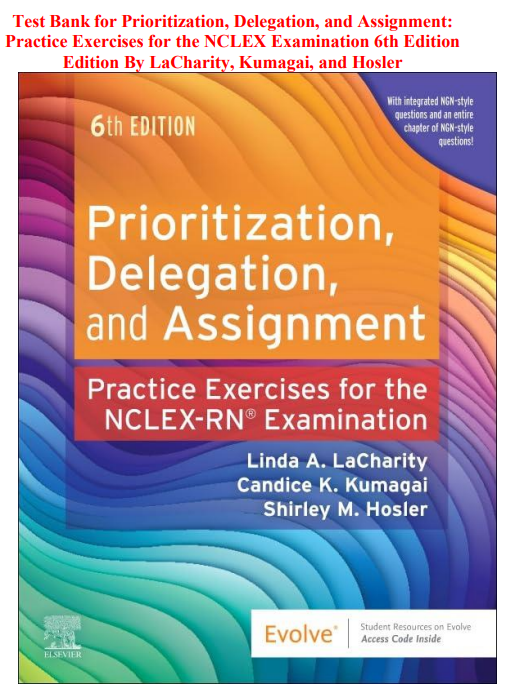
This test bank is built around the 6th edition of Prioritization, Delegation, and Assignment: Practice Exercises for the NCLEX Examination by LaCharity, Kumagai, and Hosler. It follows the same case-based structure as the textbook, so your practice actually mirrors the reasoning style you’ll need on exam day.
Whether you’re finishing nursing school, prepping for boards, or brushing up before returning to clinical practice, this resource sharpens the exact skill set that trips up so many test-takers.
What This Test Bank Covers
The textbook organizes content around patient care units and clinical scenarios, and this test bank follows that same approach. You’ll find questions covering:
- Prioritizing care among multiple patients
- Delegating tasks to LPNs, LVNs, and unlicensed assistive personnel
- Assigning patients based on acuity and staff skill level
- Medical-surgical patient scenarios
- Maternal-newborn and pediatric patient scenarios
- Psychiatric and mental health patient scenarios
- Critical care and emergency department scenarios
- Community and long-term care settings
- Scope of practice differences across the care team
- Time management and clinical decision-making
If a chapter exists in the textbook, this test bank has questions built around it.
Why This Test Bank Stands Out
1. It’s Organized the Way the Textbook Teaches It
Questions are grouped by clinical setting and patient population, just like the 6th edition. That makes it easy to target the exact skill area you’re struggling with.
2. It Trains Judgment, Not Recall
You won’t find simple definition questions here. Every question asks you to weigh multiple patients or tasks against each other and decide what matters most right now. That’s exactly what NCLEX-style prioritization questions demand.
3. Rationales Explain the Reasoning, Not Just the Answer
Getting a prioritization question right by instinct isn’t the same as understanding why. Each question breaks down the clinical reasoning behind the correct choice and explains why the other options rank lower.
4. Written in Clear, Direct Language
Prioritization scenarios can get wordy fast, with several patients and details to track. This test bank keeps the language tight and easy to follow so you can focus on the decision, not the reading.
5. Built for Repeated Practice
Prioritization skills improve with repetition. This test bank is designed for multiple passes, not just a single read-through.
Who This Test Bank Is For
- Nursing students preparing for the NCLEX-RN or NCLEX-PN
- Students in their final semester before graduation
- Nursing instructors building case-based exam questions
- New graduate nurses reviewing before starting orientation
- Nurses returning to practice after time away from the bedside
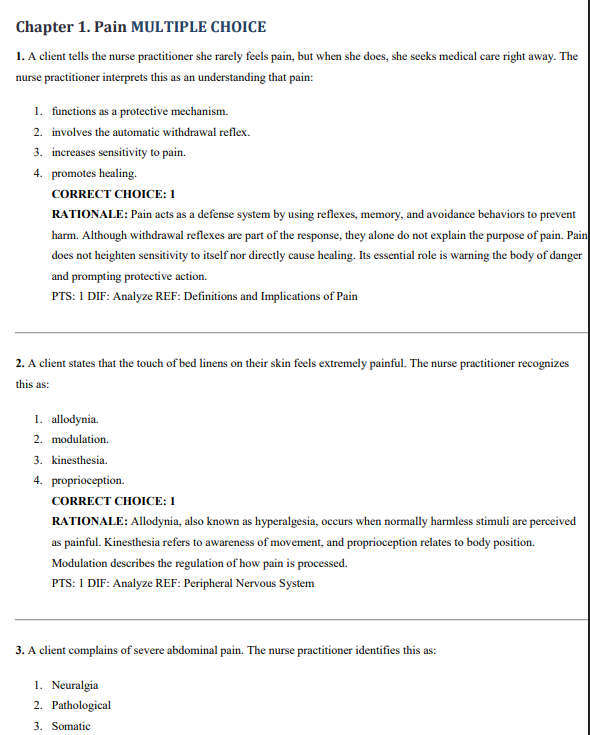
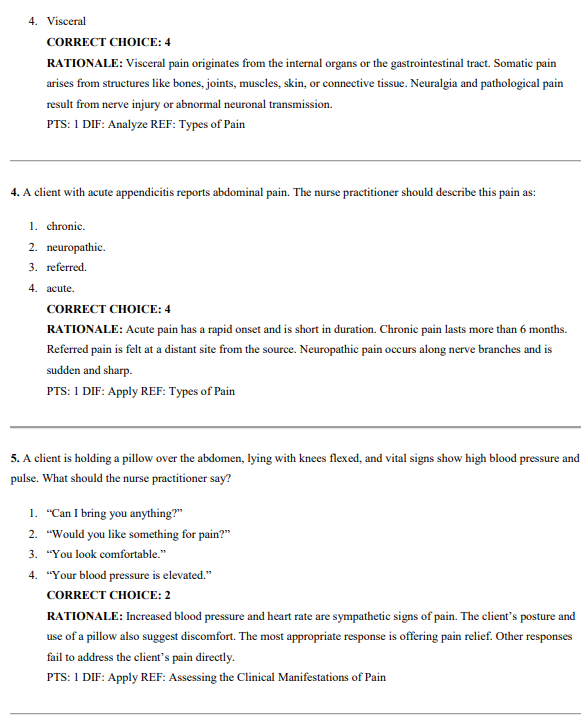
Sample Practice Questions
Here are five sample questions written in the same style and difficulty level as the full test bank.
Question 1: Prioritization
A nurse is assigned to four patients at the start of a shift. Which patient should the nurse assess first?
A) A patient scheduled for discharge teaching this morning
B) A patient reporting new-onset chest pain and shortness of breath
C) A patient requesting a refill of their water pitcher
D) A patient due for a routine dressing change in an hour
Correct Answer: B) A patient reporting new-onset chest pain and shortness of breath
Rationale: New-onset chest pain with shortness of breath could signal a life-threatening cardiac or respiratory event and requires immediate assessment. Discharge teaching, water pitcher requests, and scheduled dressing changes are all important but not urgent, and none of them pose an immediate threat to patient safety.
Question 2: Delegation
Which task can the nurse safely delegate to unlicensed assistive personnel (UAP)?
A) Assessing a postoperative patient’s incision for signs of infection
B) Assisting a stable patient with ambulation to the bathroom
C) Teaching a newly diagnosed diabetic patient how to self-administer insulin
D) Evaluating a patient’s response to a new pain medication
Correct Answer: B) Assisting a stable patient with ambulation to the bathroom
Rationale: Assisting a stable patient with ambulation is within the scope of UAP, since it doesn’t require nursing assessment or judgment. Wound assessment, patient teaching, and evaluating medication response all require nursing knowledge and licensure, which means they cannot be delegated to unlicensed staff.
Question 3: Assignment
A charge nurse is making patient assignments for the shift. Which patient is most appropriate to assign to a newly licensed RN?
A) A patient in septic shock requiring vasopressor titration
B) A stable patient recovering from an uncomplicated appendectomy
C) A patient actively experiencing a hypertensive crisis
D) A patient with an unstable cardiac rhythm requiring frequent monitoring
Correct Answer: B) A stable patient recovering from an uncomplicated appendectomy
Rationale: A stable, predictable patient recovering from routine surgery is appropriate for a newly licensed RN who is still building clinical experience. Patients in septic shock, hypertensive crisis, or with unstable cardiac rhythms require the judgment and quick decision-making of a more experienced nurse.
Question 4: Prioritization in the Emergency Department
Using triage principles, which patient should be seen first in the emergency department?
A) A patient with a sprained ankle rating pain as 6 out of 10
B) A patient with a laceration that stopped bleeding an hour ago
C) A patient with sudden slurred speech and facial drooping
D) A patient requesting a refill of a routine prescription
Correct Answer: C) A patient with sudden slurred speech and facial drooping
Rationale: Sudden slurred speech and facial drooping are classic signs of a stroke, a time-sensitive emergency where rapid treatment significantly affects outcomes. A sprained ankle, a laceration that has already stopped bleeding, and a routine prescription refill can all safely wait, since none of them pose an immediate threat to life or long-term function.
Question 5: Delegation to LPN/LVN
Which task is within the scope of practice for a licensed practical nurse (LPN) working under the supervision of an RN?
A) Developing the initial nursing care plan for a new admission
B) Administering a scheduled oral medication to a stable patient
C) Completing the admission assessment for a new patient
D) Providing discharge teaching for a complex new diagnosis
Correct Answer: B) Administering a scheduled oral medication to a stable patient
Rationale: LPNs can administer many routine medications to stable patients under RN supervision, as this falls within their scope of practice. Developing a care plan, completing an admission assessment, and providing complex discharge teaching all require the broader scope of practice and clinical judgment held by an RN.
These five questions only scratch the surface. The full test bank includes hundreds of case-based questions spanning every unit of the 6th edition.
How to Study With This Test Bank
- Work through scenarios slowly at first. Prioritization questions reward careful reading, not speed, especially when you’re still building the skill.
- Read every rationale, even for questions you get right. The reasoning behind the answer matters more than the answer itself.
- Look for patterns. Airway, breathing, and circulation concerns almost always outrank comfort or convenience requests.
- Practice delegation scope separately from prioritization. They’re related skills, but they test different knowledge, so give each its own focused review.
- Repeat missed questions after a few days. Since this skill is built through repetition, revisiting weak areas matters more here than in fact-based courses.
Why This Beats Generic NCLEX Practice Questions
Generic online question banks often lump prioritization and delegation in with basic recall questions, which waters down the practice you actually need. This test bank was built specifically around LaCharity, Kumagai, and Hosler’s 6th edition, so the scenarios, structure, and difficulty match the exact skill NCLEX tests so heavily.
Format and Delivery
This test bank is delivered as a digital file. You get instant access after purchase. No shipping. No waiting. Study from your laptop, tablet, or phone whenever you have a spare few minutes.
Frequently Asked Questions
Is this test bank the same as the textbook?
No. This is a companion study resource. You’ll still want Prioritization, Delegation, and Assignment: Practice Exercises for the NCLEX Examination, 6th Edition, for full case narratives and additional context.
Is this only useful for NCLEX prep?
Not at all. While it’s designed with NCLEX-style reasoning in mind, it’s also useful for nursing school exams that test prioritization and delegation throughout the program.
Does this cover delegation to both LPNs and UAP?
Yes. Scope of practice differences for LPNs, LVNs, and unlicensed assistive personnel are all addressed throughout the question set.
Can instructors use this to build course exams?
Yes. Instructors and TAs often use test banks like this as a base for quizzes, midterms, or final exams focused on clinical judgment.
What question formats are included?
You’ll find multiple choice, multiple response, and case-based scenario questions throughout the set.
Are rationales included for every question?
Yes. Each question includes an explanation of why the correct answer ranks highest and why the other choices rank lower.
Is this appropriate for new graduate nurses?
Yes. Many new grads use resources like this to sharpen prioritization skills before starting hospital orientation.
How is this different from a general medical-surgical test bank?
A med-surg test bank tests disease knowledge. This test bank tests decision-making, specifically who to see first, what to delegate, and how to assign patients safely.
Final Thoughts
Prioritization and delegation aren’t skills you can memorize your way through. They’re skills you build by practicing real decisions, over and over, until the reasoning becomes second nature. This test bank for the 6th edition of Prioritization, Delegation, and Assignment gives you exactly that kind of repeated, realistic practice. Clear scenarios. Honest rationales. A study tool built around the exact skill your exam is testing.
Grab your copy today and walk into your exam ready to think like a nurse.

Lucas Gabriel –
Easy to use and helpful for focused studying.
Rosemary R –
Excellent resource for practicing priority nursing questions
Peterson S. –
Helped me review important concepts more efficiently
Vmansteain –
A solid study resource for nursing students.
Kamara Reid –
Definitely worth using alongside regular coursework
Tess Mwaure –
This tool has really made mu study session more productive
Sarah Willock –
Questions help make revision more intentional and focused.
Phil Mark –
Helpful material for practicing between longer study sessions.
Aadhya Priya –
A convenient way to check understanding after reading.
Doris King –
Useful questions for reviewing material in a structured sequence.