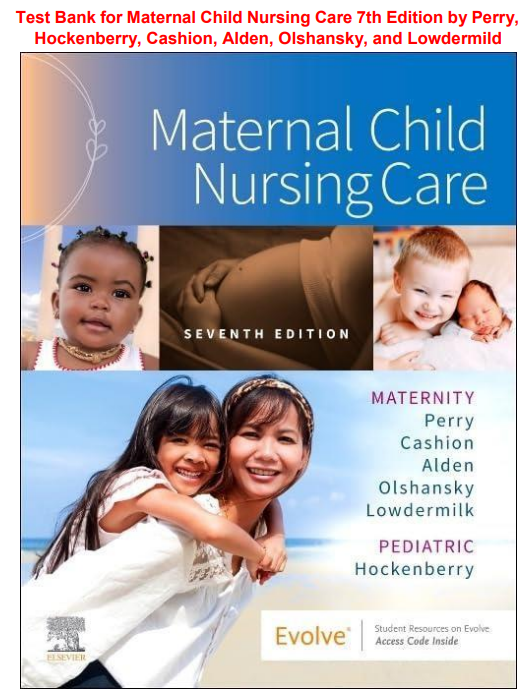
Maternal child nursing sits at the heart of some of the most meaningful moments in human life. Birth, newborn transition, childhood growth and development, acute pediatric illness, and the full arc of the childbearing experience from preconception through postpartum recovery. These are not abstract clinical events. They involve real families in deeply vulnerable moments, and the nurses who care for them carry an enormous responsibility. The knowledge required is broad, detailed, and constantly applied under pressure. Reading the textbook is only the beginning. To perform confidently in clinical practice and succeed on examinations, you need to test yourself repeatedly against content that reflects the real complexity of what you will face. That is exactly what this test bank delivers.
Every question in this resource follows the 7th edition chapter structure, authored by one of the most experienced and respected teams in maternal child nursing education. The coverage is extensive and carefully balanced across both domains of the textbook. On the maternity side, you will find questions covering preconception care, prenatal development and nutrition, antepartum assessment, complications of pregnancy, labor and delivery, fetal monitoring, pain management in labor, operative deliveries, postpartum care, breastfeeding, and reproductive health. On the pediatric side, the content spans child health assessment across developmental stages, communicable diseases, respiratory disorders, cardiovascular conditions, gastrointestinal and renal problems, neurological conditions, musculoskeletal disorders, hematologic conditions, and pediatric oncology. No major content area has been left out.
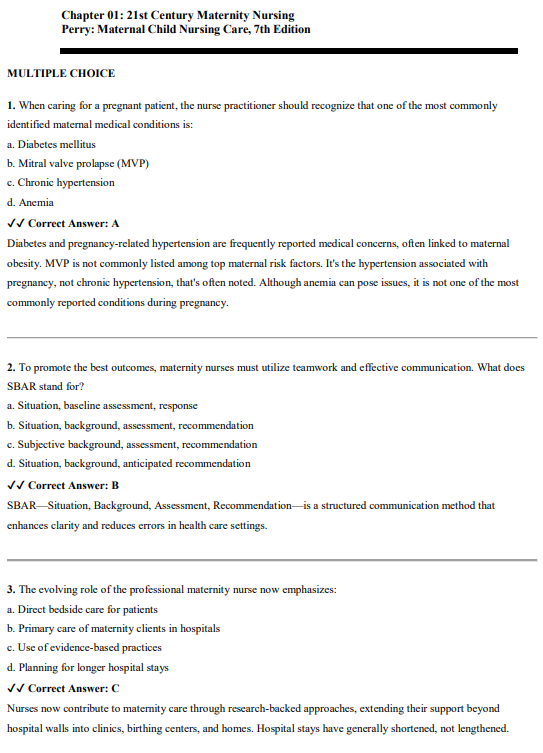
What distinguishes this test bank from basic question-and-answer resources is the quality of its explanations. Every question is followed by the correct answer and a thorough, well-reasoned rationale. These rationales do not simply restate which option is right. They explain the physiological or clinical reasoning that makes the correct answer the best choice, address why each of the remaining options is incorrect, and where relevant, connect the content to the nursing process or NCLEX framework. That level of explanation means each question functions as both an assessment and a learning tool. You are not just checking your knowledge. You are deepening it.
The file is a fully searchable PDF. When you need to focus your review on antepartum complications before a maternity exam, or work through respiratory disorders in pediatric patients before a clinical rotation, use Ctrl+F to get exactly where you need to be in seconds. No time spent scrolling through unrelated chapters. No disruption to your study momentum. Just clean, direct access to the content you need, when you need it.
Your download link is generated the moment your purchase is confirmed. There is no waiting period, no account creation, and no approval process standing between you and your study material. Open the file on any device and begin immediately. The file is yours permanently. No subscription, no renewal fee, no expiry date.
What You Get
- Full chapter coverage matched to the 7th edition layout across both maternity and pediatric content
- Scenario-based multiple-choice questions grounded in clinical practice and the nursing process
- Every question answered with the correct response clearly identified
- Detailed rationales explaining the reasoning and addressing all answer options
- Searchable PDF format for fast, targeted review by topic, condition, or care stage
- One-time purchase with permanent, unlimited file access
Who This Is For
Nursing students enrolled in maternal child nursing courses will benefit most directly from this resource. It covers both the maternity and pediatric content areas in a single, integrated resource that mirrors the structure of the textbook itself. It is also an excellent tool for students preparing for NCLEX, where maternal child health content is a consistently high-yield testing area. Additionally, RNs transitioning into labor and delivery, postpartum, neonatal, or pediatric nursing roles will find this test bank a practical and well-organized way to refresh and consolidate their knowledge before entering a new clinical environment.
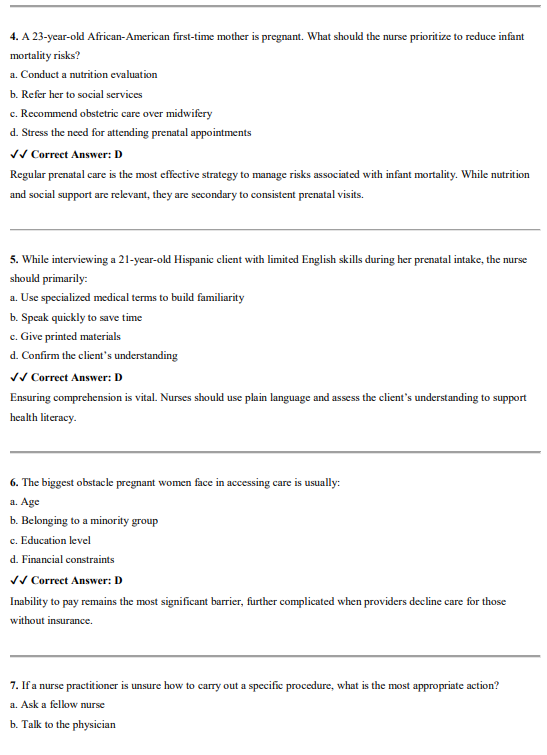
Sample Questions
Question 1
A nurse is caring for a patient at 32 weeks of gestation who presents with sudden, painless, bright red vaginal bleeding. The patient’s vital signs are stable and the fetal heart rate is within normal limits. Which condition should the nurse suspect, and what is the priority nursing action?
A) Placental abruption; prepare the patient for immediate cesarean delivery
B) Placenta previa; place the patient on bed rest, avoid vaginal examinations, and notify the provider
C) Bloody show; reassure the patient that this is a normal sign of approaching labor
D) Umbilical cord prolapse; place the patient in Trendelenburg position and call for emergency assistance
Correct Answer: B
Detailed Explanation:
Placenta previa occurs when the placenta implants in the lower uterine segment, partially or completely covering the internal cervical os. The hallmark presentation is sudden, painless, bright red vaginal bleeding in the second or third trimester, which is exactly what this patient is experiencing. The bleeding occurs because the lower uterine segment begins to thin and stretch in preparation for labor, disrupting the placental attachment. Because any cervical examination could precipitate catastrophic hemorrhage by further disturbing the placental implantation site, vaginal examinations are strictly contraindicated until placenta previa has been ruled out by ultrasound. The priority interventions are bed rest, continuous fetal monitoring, notification of the provider, and preparation for possible emergency delivery if bleeding becomes uncontrolled.
Option A is incorrect because placental abruption typically presents with sudden, painful, dark red bleeding and a rigid or tender uterus, not painless bright red bleeding. While abruption can occasionally be painless, the clinical picture described fits placenta previa more precisely. Option C is incorrect because bloody show is a small amount of pink or blood-tinged mucus associated with cervical dilation and is not characterized by bright red vaginal bleeding of the nature described. Option D is incorrect because umbilical cord prolapse presents with variable or prolonged fetal heart rate decelerations following rupture of membranes, and the priority intervention is to relieve cord compression manually while preparing for immediate delivery, not the actions described in the other options.
Question 2
A postpartum nurse assesses a patient who delivered vaginally 90 minutes ago. The patient’s fundus is firm, located two centimeters above the umbilicus, and deviated to the right. Lochia is moderate and rubra. Vital signs are stable. What is the most likely cause of fundal deviation, and what should the nurse do first?
A) The uterus is undergoing normal involution; continue routine monitoring
B) The patient likely has a distended bladder; assist her to void or insert a urinary catheter if unable
C) The fundal deviation suggests retained placental fragments; notify the provider immediately
D) The patient is developing uterine atony; perform vigorous fundal massage and increase IV oxytocin
Correct Answer: B
Detailed Explanation:
In the immediate postpartum period, fundal deviation to one side, most commonly the right, is a classic sign of a distended bladder. The bladder sits just anterior to the uterus, and as it fills with urine, it pushes the uterus upward and to the side. A fundus that is firm but displaced is not uterine atony. It is a bladder problem. If the bladder remains distended and is not emptied, it will prevent the uterus from contracting properly, which can eventually lead to postpartum hemorrhage. The immediate nursing action is to assist the patient to void. If she is unable to void spontaneously within a reasonable timeframe, urinary catheterization may be necessary.
Option A is incorrect because fundal deviation is not a normal finding during involution. Normal involution involves the uterus descending approximately one centimeter per day and remaining in the midline. Option C is incorrect because retained placental fragments typically present with a boggy, poorly contracted uterus and heavier than expected bleeding, not a firm but deviated uterus. Option D is incorrect because the fundus is already firm, which means uterine atony is not the issue here. Performing fundal massage on a firm uterus is unnecessary and can be painful and traumatic to the patient.
Question 3
A nurse is caring for a 4-year-old child admitted with a diagnosis of nephrotic syndrome. The parents ask why their child’s abdomen looks so swollen when the problem is with the kidneys. Which explanation should the nurse provide?
A) The kidneys are enlarged from infection and are pushing the abdominal contents outward
B) The child’s body is retaining fluid in the tissues because large amounts of protein are being lost in the urine, lowering the osmotic pressure in the blood vessels
C) The child’s liver is producing too much albumin in response to the kidney disease, causing fluid to shift into the abdominal cavity
D) The swelling is caused by constipation that frequently occurs as a side effect of the medications used to treat kidney disease
Correct Answer: B
Detailed Explanation:
Nephrotic syndrome is characterized by massive proteinuria, hypoalbuminemia, hyperlipidemia, and generalized edema. The sequence of events that produces the edema begins in the glomeruli. In nephrotic syndrome, the glomerular filtration barrier becomes abnormally permeable, allowing large amounts of plasma proteins, particularly albumin, to leak into the urine. As plasma albumin levels fall, the oncotic pressure within the blood vessels drops significantly. Oncotic pressure is what normally holds fluid within the vascular space. When it falls, fluid shifts from the intravascular compartment into the interstitial spaces throughout the body. This produces the generalized, pitting edema that is the hallmark clinical feature of nephrotic syndrome, including periorbital edema, dependent edema, and the ascites that makes the abdomen appear distended.
Option A is incorrect because nephrotic syndrome is not primarily an infectious condition, and enlarged kidneys pushing on abdominal contents is not the mechanism of abdominal swelling. Option C is incorrect because the liver actually produces less albumin relative to what is being lost, contributing to hypoalbuminemia rather than correcting it. The liver does attempt to compensate by increasing lipoprotein synthesis, which contributes to hyperlipidemia. Option D is incorrect because constipation is not the cause of the abdominal distension in nephrotic syndrome, and this explanation would be both inaccurate and potentially alarming to the family without being helpful.
Question 4
A nurse is monitoring a patient in active labor who is receiving oxytocin augmentation. The fetal monitor shows uterine contractions occurring every two minutes, lasting 95 seconds, with incomplete uterine relaxation between contractions. The fetal heart rate baseline is 155 bpm with minimal variability and late decelerations. What is the priority nursing action?
A) Decrease the oxytocin infusion rate by half and reposition the patient
B) Discontinue the oxytocin infusion, reposition the patient to the left lateral position, administer oxygen, increase the IV fluid rate, and notify the provider immediately
C) Continue the current oxytocin rate and document the findings for the provider’s review at the next assessment
D) Increase the IV fluid rate and apply a fetal scalp electrode for more accurate monitoring
Correct Answer: B
Detailed Explanation:
This clinical scenario describes uterine tachysystole, defined as more than five contractions in ten minutes or contractions lasting longer than 90 seconds, combined with signs of fetal compromise including minimal variability and late decelerations. Late decelerations are caused by uteroplacental insufficiency. They occur after the peak of a contraction and indicate that the fetus is not receiving adequate oxygen during and after contractions. When combined with tachysystole, this pattern represents a serious fetal emergency requiring immediate intervention.
The correct sequence of actions follows a well-established protocol. Discontinuing the oxytocin removes the stimulus causing the excessive uterine activity. Repositioning to the left lateral position relieves aortocaval compression and improves placental blood flow. Supplemental oxygen increases the oxygen available to cross the placenta. Increasing the IV fluid rate improves maternal blood volume and placental perfusion. Notifying the provider is essential so that a decision about delivery can be made promptly if the fetal heart rate pattern does not improve.
Option A is incorrect because merely decreasing the rate is insufficient when there is already evidence of fetal compromise. The oxytocin must be stopped entirely. Option C is dangerous and incorrect. Continuing the current infusion in the presence of uterine tachysystole and an ominous fetal heart rate pattern is a direct threat to fetal wellbeing and represents a failure to act on a clinical emergency. Option D is incorrect because increasing fluid and adding monitoring does not address the underlying problem of excessive uterine activity compressing the placenta and compromising fetal oxygenation.
Question 5
A nurse is assessing a 9-month-old infant during a well-child visit. Which finding should the nurse report to the provider as a potential developmental concern?
A) The infant is not yet walking independently
B) The infant does not respond to their name when called and does not babble consonant sounds
C) The infant shows stranger anxiety when the nurse approaches
D) The infant is able to sit without support but cannot yet pull to a standing position
Correct Answer: B
Detailed Explanation:
By 9 months of age, infants are expected to respond to their own name, recognize familiar versus unfamiliar faces, and produce consonant babbling sounds such as “ba,” “da,” and “ma.” These behaviors reflect both auditory processing and early language development. A 9-month-old who does not respond to their name and does not babble may be showing early signs of hearing impairment, autism spectrum disorder, or a speech and language delay. These are red flags that warrant further evaluation and should be reported to the provider rather than attributed to normal variation.
Option A is incorrect because independent walking typically develops between 9 and 12 months, with some children not walking until 15 months. At 9 months, not walking is entirely within the range of normal development. Option C is incorrect because stranger anxiety is a developmentally expected and healthy finding at this age. It reflects normal attachment development and the infant’s growing ability to distinguish caregivers from unfamiliar people. Option D is incorrect because sitting without support is typically achieved around 6 to 8 months, and pulling to stand usually develops between 9 and 12 months. A 9-month-old who can sit independently but has not yet pulled to stand is progressing normally.
FAQ
Is this an official publisher product?
No. This is an independently written study resource structured around the topics and chapter layout of the 7th edition. It is not affiliated with or endorsed by the authors or their publisher.
Will these questions match my course exams or NCLEX questions?
This test bank is designed to build deep clinical reasoning across both maternity and pediatric nursing so you are prepared for any assessment format. It does not preview specific instructor exams or licensed board questions.
What makes this test bank different from others?
The detailed rationales go well beyond identifying the correct answer. They explain the clinical reasoning, address the physiology or developmental principles involved, and clarify why each incorrect option fails. That approach builds the kind of understanding that holds up under exam pressure and in clinical practice.
What file format will I receive?
A fully searchable PDF, navigable by chapter, condition, care stage, or keyword using any standard PDF reader on any device.
How quickly can I access the file after purchase?
Instantly. Your download link is generated immediately after checkout with no waiting period or additional steps required.
Can I open this on my phone or tablet?
Yes. The PDF opens cleanly on any iOS or Android device using a free PDF reader app with no formatting issues.
Do I need the textbook to use this?
Having the textbook alongside is helpful since the chapter order mirrors the 7th edition closely. The questions and rationales are also written in enough detail to be used independently for targeted review and exam preparation.
Is there a subscription or renewal fee?
No. This is a one-time purchase. The file is yours to keep and use as many times as you need with no recurring charges or expiry date.

Reviews
There are no reviews yet.