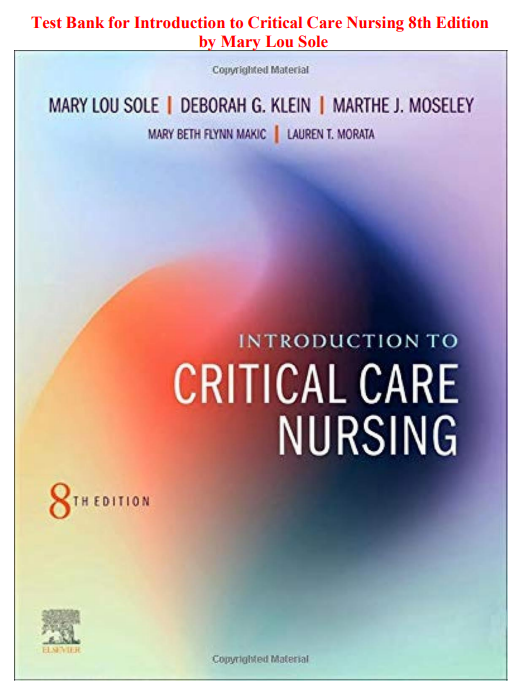
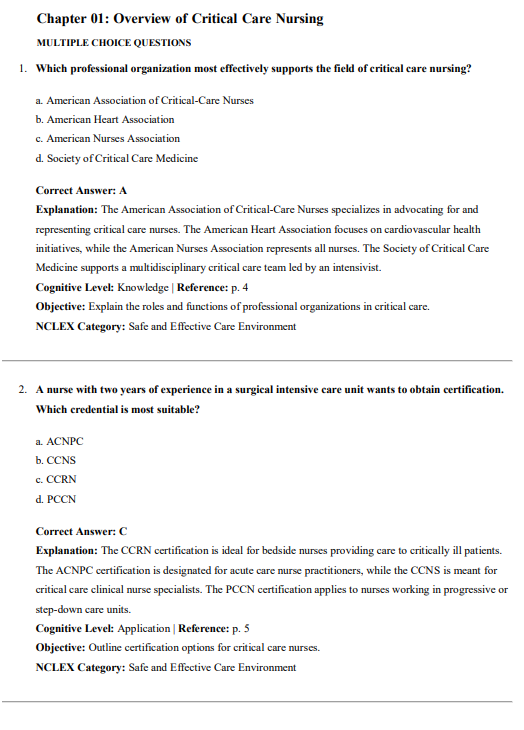
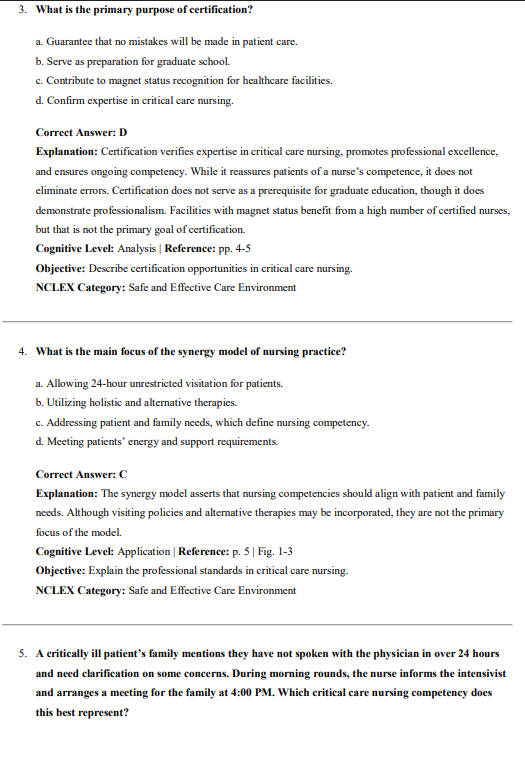
Critical care nursing is where the full weight of clinical knowledge meets the urgency of life-threatening illness. The patients in an intensive care unit are the most vulnerable in the entire hospital. Their physiological reserves are depleted. Their organ systems are failing or at risk of failing. Their trajectories can change within minutes. The nurses who care for them must be capable of interpreting a deteriorating hemodynamic profile, responding to a ventilator alarm, recognizing the early signs of septic shock, and communicating a complex clinical picture to a multidisciplinary team, all within the same hour, sometimes within the same shift. That level of clinical competence is not built by reading alone. It is built through sustained, deliberate practice with content that reflects the true depth and pace of critical care nursing. That is what this test bank delivers.
Introduction to Critical Care Nursing by Mary Lou Sole has long been one of the most respected and widely used texts in critical care nursing education. The 8th edition carries that legacy forward with thoroughly updated content, expanded evidence-based practice references, and a stronger emphasis on the clinical reasoning skills that nurses need to practice safely and effectively in high-acuity environments. It is a textbook that does not shy away from the complexity of critical care. It builds competence systematically, from the foundational concepts of hemodynamic monitoring and oxygenation through the management of specific organ system failures and the ethical dimensions of end-of-life care in the ICU. This test bank was written to match that depth of clinical focus at every level.
Every question in this resource follows the 8th edition chapter structure. The coverage is thorough and carefully sequenced across the full scope of the textbook. Questions address the critical care environment and the role of the critical care nurse, hemodynamic monitoring and interpretation, airway management and mechanical ventilation, pain, sedation, and delirium management, cardiovascular disorders including acute coronary syndromes, heart failure, and dysrhythmias, respiratory failure and acute respiratory distress syndrome, neurological emergencies including traumatic brain injury, stroke, and status epilepticus, renal failure and renal replacement therapy, sepsis and septic shock, gastrointestinal critical illness, hematological emergencies, endocrine crises including diabetic ketoacidosis and thyroid storm, multisystem trauma, and end-of-life care and ethical decision-making in the ICU. No major critical care content area has been left out.
What sets this test bank apart from basic review collections is the quality and clinical precision of its answer explanations. Every question presents a realistic ICU scenario, clearly identifies the correct answer, and follows it with a thorough, well-reasoned rationale. These rationales do not simply confirm what is right. They explain the physiological or clinical reasoning behind the correct choice, address why each of the remaining options is incorrect, and connect the content to nursing priorities, hemodynamic principles, ventilator management strategies, and the safety frameworks that govern critical care nursing practice. That depth of explanation means every question functions as both an assessment and a learning tool. You are not just checking your knowledge. You are deepening your ability to think like a critical care nurse, which is the only preparation that actually translates into safe, confident ICU practice.
The file is a fully searchable PDF. When you need to review arterial blood gas interpretation before a ventilator management competency, consolidate your understanding of vasopressor therapy before a critical care clinical rotation, or drill questions on sepsis recognition and bundle compliance before a certification examination, use Ctrl+F to navigate directly to that content in seconds. No time lost scrolling through chapters you have already covered. No disruption to your concentration. Precise, targeted access to exactly the material you need at the moment you need it.
Your download link is generated the moment your purchase is confirmed. No waiting period, no account creation, and no approval process. Open the file on your laptop, tablet, or phone and begin working through it immediately. The file is yours permanently. No subscription, no renewal fee, and no expiry date.
What You Get
- Full chapter coverage matched to the 8th edition layout across all critical care content areas
- Clinically grounded ICU scenario-based multiple-choice questions reflecting real critical care complexity
- Every question answered with the correct response clearly identified
- Detailed rationales explaining the physiological reasoning and addressing all answer options
- Searchable PDF format for fast, targeted review by organ system, condition, or clinical concept
- One-time purchase with permanent, unlimited file access
Who This Is For
Nursing students enrolled in critical care nursing courses or completing ICU clinical rotations will benefit most directly from this resource. It mirrors the chapter structure of the Sole textbook closely and is designed to support students as they navigate one of the most intellectually demanding content areas in nursing education. It is also an excellent preparation tool for nurses pursuing the CCRN certification examination administered by the American Association of Critical-Care Nurses, where clinical judgment in high-acuity situations is the central testing domain. New graduate nurses entering ICU or step-down positions through critical care residency programs will find this test bank a structured and clinically focused way to build the foundational knowledge their orientation requires. Experienced nurses transitioning into new critical care subspecialties, including cardiac surgery ICU, medical ICU, neurological ICU, and trauma ICU environments, will also benefit from the breadth and depth of this resource.
Sample Questions
Question 1
A critical care nurse is monitoring a patient who is 18 hours post-operative following emergent repair of a ruptured abdominal aortic aneurysm. The patient is intubated and mechanically ventilated. The arterial line waveform shows a systolic blood pressure of 82 mmHg, diastolic of 48 mmHg, and a mean arterial pressure of 59 mmHg. The pulmonary artery catheter readings show a cardiac output of 2.8 L/min, cardiac index of 1.4 L/min/m², pulmonary capillary wedge pressure of 4 mmHg, and systemic vascular resistance of 1,840 dynes/sec/cm⁻⁵. The patient’s urine output over the past two hours has been 18 mL total. Which hemodynamic profile does this data represent, and what is the priority intervention?
A) Cardiogenic shock with elevated filling pressures; initiate dobutamine infusion and restrict IV fluids to prevent pulmonary edema
B) Distributive shock with low systemic vascular resistance; initiate norepinephrine and reassess hemodynamics
C) Hypovolemic shock with low filling pressures and low cardiac output; administer an IV fluid bolus and reassess hemodynamics and urine output
D) Obstructive shock from cardiac tamponade; prepare the patient for emergency pericardiocentesis
Correct Answer: C
Detailed Explanation:
Interpreting pulmonary artery catheter data requires systematic analysis of all hemodynamic parameters together rather than reacting to any single value in isolation. In this question, the data paints a clear and consistent picture of hypovolemic shock. The mean arterial pressure of 59 mmHg is below the minimum target of 65 mmHg required for adequate organ perfusion. The cardiac output of 2.8 L/min and cardiac index of 1.4 L/min/m² are significantly reduced, confirming that the heart is not delivering adequate blood flow to meet the body’s metabolic demands. The normal cardiac index range is 2.5 to 4.0 L/min/m². The pulmonary capillary wedge pressure of 4 mmHg is critically low, indicating that the left ventricle has insufficient preload, meaning insufficient filling volume, to generate an adequate stroke volume. Normal wedge pressure ranges from 8 to 12 mmHg. The elevated systemic vascular resistance of 1,840 dynes/sec/cm⁻⁵ reflects the body’s compensatory vasoconstriction in response to low cardiac output, a hallmark of both hypovolemic and cardiogenic shock. The oliguria, only 18 mL over two hours, is a direct consequence of inadequate renal perfusion from low cardiac output and MAP.
In the context of emergent aortic aneurysm repair, hypovolemia is the most clinically expected and physiologically consistent explanation for this hemodynamic profile. Surgical blood loss, third-space fluid shifts, and inadequate intraoperative replacement are common contributors. The priority intervention is volume resuscitation with an IV fluid bolus, guided by repeat hemodynamic assessment to evaluate response. As the PCWP and cardiac output improve with volume loading, the MAP and urine output should respond accordingly.
Option A is incorrect because cardiogenic shock produces a high PCWP reflecting a congested, overfilled left ventricle that cannot pump effectively, not the low PCWP of 4 mmHg seen here. Option B is incorrect because distributive shock, which includes septic and anaphylactic shock, is characterized by a low systemic vascular resistance reflecting pathological vasodilation, not the elevated SVR of 1,840 seen in this patient. Option D is incorrect because cardiac tamponade produces obstructive shock with elevated and equalized filling pressures across all cardiac chambers, including an elevated PCWP, not the depleted preload reflected here.
Question 2
A nurse in the medical ICU is caring for a patient on mechanical ventilation in volume-controlled assist-control mode with the following settings: tidal volume 500 mL, respiratory rate 14 breaths per minute, FiO2 0.60, PEEP 8 cmH2O. The patient weighs 71 kg and is 170 cm tall. The most recent arterial blood gas shows pH 7.32, PaCO2 52 mmHg, PaO2 61 mmHg, HCO3 26 mEq/L, SaO2 91%. Peak inspiratory pressure is 38 cmH2O and plateau pressure obtained during an inspiratory hold is 32 cmH2O. Which ventilator management concern does this data most clearly identify, and what adjustment should the nurse anticipate?
A) The tidal volume is too high and contributing to ventilator-induced lung injury; the provider should reduce the tidal volume to a lung-protective target of 6 mL/kg of ideal body weight
B) The PEEP is excessive and causing barotrauma; the provider should decrease PEEP to 5 cmH2O and reassess oxygenation
C) The FiO2 is too low to correct the hypoxemia; the provider should increase FiO2 to 1.0 immediately
D) The respiratory rate is too high and causing auto-PEEP; the provider should decrease the rate to 8 breaths per minute
Correct Answer: A
Detailed Explanation:
Lung-protective ventilation is one of the most evidence-based and critically important principles in mechanical ventilation management, supported by landmark trials including the ARDSNet study published in the New England Journal of Medicine. The core principle is that large tidal volumes overstretch alveoli, causing repetitive mechanical injury to the alveolar walls, a phenomenon called volutrauma, which perpetuates and worsens lung injury.
To calculate the appropriate tidal volume, ideal body weight rather than actual body weight must be used, because it is the lung size that determines safe tidal volume capacity, and lung size correlates with height and gender rather than total body mass. For this patient, who is male at 170 cm, the ideal body weight can be estimated at approximately 70 kg. The lung-protective tidal volume target is 6 mL/kg of ideal body weight, which would be approximately 420 mL for this patient. The current tidal volume of 500 mL corresponds to approximately 7 mL/kg of ideal body weight, which exceeds the protective threshold and increases the risk of ventilator-induced lung injury, particularly in patients with ARDS or other forms of diffuse lung injury where heterogeneous alveolar disease means that delivered volume is preferentially distributed to healthier, more compliant alveolar units, causing overdistension.
The plateau pressure of 32 cmH2O is also at the upper boundary of the acceptable range. Lung-protective strategies target plateau pressure below 30 cmH2O. Reducing the tidal volume will lower both peak and plateau pressures, reducing the mechanical stress on the alveoli.
Option B is incorrect because a PEEP of 8 cmH2O is within a clinically reasonable range and the plateau pressure, not PEEP, is the primary concern here. PEEP titration is guided by oxygenation response and plateau pressure trends. Option C is incorrect because jumping immediately to FiO2 of 1.0 is not the appropriate first response to mild to moderate hypoxemia. A PaO2 of 61 mmHg with SaO2 of 91% on FiO2 0.60 suggests that PEEP optimization and tidal volume adjustment may improve oxygenation more safely than escalating FiO2, which at high levels causes oxygen toxicity with prolonged exposure. Option D is incorrect because the respiratory rate of 14 is not excessive and auto-PEEP is not the primary concern identified by this data. Auto-PEEP is more commonly associated with high respiratory rates combined with insufficient expiratory time, which is not the pattern described here.
Question 3
A critical care nurse is caring for a 55-year-old patient admitted with a hypertensive emergency. The patient’s blood pressure on arrival was 224/136 mmHg. The provider has ordered an intravenous nicardipine infusion titrated to achieve a target mean arterial pressure reduction of 20 to 25 percent within the first hour. Thirty minutes into the infusion, the patient reports blurred vision and develops sudden confusion and right-sided arm weakness. The blood pressure at this moment reads 148/88 mmHg. What is the most likely explanation for the new neurological findings, and what is the priority nursing action?
A) The patient’s neurological symptoms are an expected side effect of nicardipine; continue the infusion and reassess in 30 minutes
B) The blood pressure has been reduced too rapidly, causing cerebral hypoperfusion; decrease or stop the nicardipine infusion, notify the provider immediately, and prepare for emergent neurological evaluation
C) The patient is developing hypertensive encephalopathy from inadequate blood pressure control; increase the nicardipine infusion rate to further lower the blood pressure
D) The patient is experiencing a nicardipine-induced allergic reaction; stop the infusion, administer diphenhydramine, and switch to a labetalol infusion
Correct Answer: B
Detailed Explanation:
This question addresses one of the most dangerous and clinically nuanced principles in hypertensive emergency management: the paradoxical risk of lowering blood pressure too quickly in patients with chronic severe hypertension. In patients who have lived with chronically elevated blood pressure, cerebral autoregulation, the physiological mechanism that maintains constant cerebral blood flow across a wide range of perfusion pressures, shifts its operating range upward to accommodate the chronically high pressures. This means that the brain of a chronically hypertensive patient may require a significantly higher MAP to maintain adequate perfusion than a normotensive patient would.
When blood pressure is reduced too rapidly, the cerebral autoregulatory mechanism cannot compensate quickly enough, and cerebral blood flow drops precipitously, causing cerebral hypoperfusion and ischemia. This manifests clinically as the acute neurological findings described in this question, including confusion, visual disturbances, and focal motor deficits. These findings closely mimic an ischemic stroke and must be evaluated urgently, but in this context they are most immediately explained by the rate of blood pressure reduction achieved in the 30 minutes since the infusion began.
The current blood pressure of 148/88 mmHg represents a reduction from 224/136 mmHg that exceeds the recommended 20 to 25 percent reduction target in the first hour. Guidelines for hypertensive emergency management specifically caution against rapid normalization of blood pressure precisely because of this risk. The nicardipine infusion must be decreased or stopped, the provider must be notified immediately, and the patient requires urgent neurological assessment including CT imaging to evaluate for ischemic or hemorrhagic stroke.
Option A is incorrect because neurological deterioration including focal weakness and confusion are not expected pharmacological side effects of nicardipine. These findings represent a clinical emergency. Option C is incorrect because further lowering the blood pressure in a patient already experiencing neurological signs of cerebral hypoperfusion would worsen the ischemia. Option D is incorrect because the clinical picture is not consistent with an allergic reaction, which would present with urticaria, bronchospasm, or anaphylaxis rather than focal neurological deficits.
Question 4
A critical care nurse is assessing a patient who was admitted 36 hours ago with community-acquired pneumonia and has progressively worsened. The current assessment reveals a respiratory rate of 32 breaths per minute, SpO2 of 86% on a non-rebreather mask at 15 L/min, diffuse bilateral crackles throughout all lung fields, blood pressure of 96/58 mmHg, and a PaO2/FiO2 ratio calculated at 88 mmHg. The chest X-ray shows new bilateral infiltrates not explained by cardiac failure or fluid overload. Which condition does this clinical picture represent, and what ventilator strategy is most important to implement upon intubation?
A) Cardiogenic pulmonary edema; initiate diuresis with furosemide and prepare for non-invasive positive pressure ventilation before considering intubation
B) Acute respiratory distress syndrome; initiate lung-protective ventilation with tidal volumes of 4 to 6 mL/kg of ideal body weight and titrate PEEP to optimize oxygenation while limiting plateau pressure
C) Severe asthma exacerbation; prepare for intubation with controlled hypoventilation strategy using a low respiratory rate to allow adequate expiratory time
D) Pulmonary embolism with right heart strain; prepare for emergent CT pulmonary angiography and anticoagulation before any ventilatory intervention
Correct Answer: B
Detailed Explanation:
The Berlin Definition of acute respiratory distress syndrome requires four criteria to be met: acute onset within one week of a known clinical insult or new or worsening respiratory symptoms; bilateral opacities on chest imaging not fully explained by effusions, lobar collapse, or nodules; respiratory failure not fully explained by cardiac failure or fluid overload; and decreased oxygenation defined by PaO2/FiO2 ratio. The PaO2/FiO2 ratio categorizes ARDS severity: mild is 200 to 300 mmHg, moderate is 100 to 200 mmHg, and severe is below 100 mmHg. This patient’s PaO2/FiO2 ratio of 88 mmHg places them in the severe ARDS category.
All four Berlin criteria are met in this patient: the onset is acute in the context of pneumonia, bilateral infiltrates are present on chest X-ray, cardiac failure and fluid overload have been excluded, and the PaO2/FiO2 ratio confirms severe hypoxemic respiratory failure. The patient has failed high-flow oxygen therapy through a non-rebreather mask with SpO2 remaining at 86%, indicating that intubation and mechanical ventilation are urgently needed.
The cornerstone of ventilatory management in ARDS is lung-protective ventilation, which targets tidal volumes of 4 to 6 mL/kg of ideal body weight to minimize volutrauma, plateau pressures below 30 cmH2O to minimize barotrauma, and optimized PEEP to recruit collapsed alveoli and improve oxygenation while avoiding overdistension of healthier lung units. This strategy, validated by the ARDSNet trial, has been shown to reduce mortality in ARDS patients compared to conventional ventilation with larger tidal volumes.
Option A is incorrect because the question specifically states the bilateral infiltrates are not explained by cardiac failure or fluid overload, which rules out cardiogenic pulmonary edema as the primary diagnosis. Diuresis would be inappropriate and potentially harmful in a patient with hypotension. Option C is incorrect because this is not an asthma exacerbation. Asthma presents with wheezing, bronchospasm history, and obstructive physiology, not bilateral infiltrates and diffuse crackles. Option D is incorrect because while pulmonary embolism can cause respiratory failure, the bilateral infiltrates and diffuse crackles indicate a parenchymal process rather than the vascular obstruction of PE. Delaying ventilation in a patient with SpO2 of 86% to pursue CT imaging would be life-threatening.
Question 5
A critical care nurse is caring for a patient who meets the Surviving Sepsis Campaign criteria for septic shock. The patient has a suspected intra-abdominal source of infection. It has been one hour since sepsis was identified. Which bundle elements must be completed within the first three hours of sepsis recognition, and which intervention should the nurse prioritize if only one action can be taken immediately?
A) Obtain blood cultures, administer broad-spectrum antibiotics, and initiate a vasopressor infusion; prioritize vasopressor initiation to restore blood pressure
B) Obtain blood cultures before antibiotics, measure serum lactate, administer 30 mL/kg IV crystalloid for hypotension or lactate above 4 mmol/L, and administer broad-spectrum antibiotics; prioritize antibiotic administration as the single most time-sensitive mortality-reducing intervention
C) Administer broad-spectrum antibiotics, initiate a norepinephrine infusion, and insert a pulmonary artery catheter for hemodynamic monitoring; prioritize pulmonary artery catheter insertion to guide resuscitation
D) Measure serum lactate, obtain a chest X-ray, administer antibiotics, and consult surgery for source control; prioritize the chest X-ray to identify the source of infection before antibiotics are given
Correct Answer: B
Detailed Explanation:
The Surviving Sepsis Campaign Hour-1 Bundle, updated from the earlier three-hour and six-hour bundles, identifies the core time-sensitive interventions that must be initiated immediately upon recognition of sepsis or septic shock. The bundle elements to be completed as rapidly as possible, ideally within the first hour, include measuring serum lactate and remeasuring if the initial lactate is above 2 mmol/L, obtaining blood cultures before administering antibiotics, administering broad-spectrum antibiotics, administering 30 mL/kg of IV crystalloid for hypotension or lactate of 4 mmol/L or higher, and applying vasopressors if the patient remains hypotensive during or after fluid resuscitation to maintain a mean arterial pressure of 65 mmHg or higher.
Blood cultures must be obtained before antibiotics are given to maximize the likelihood of identifying the causative organism and guiding definitive antibiotic therapy. However, the culture collection should not significantly delay antibiotic administration. If cultures cannot be obtained promptly, antibiotics should not be withheld.
The single most time-sensitive mortality-reducing intervention in sepsis management is early appropriate antibiotic administration. Multiple large studies have demonstrated a direct and consistent relationship between time to first antibiotic dose and mortality in septic patients, with each hour of delay associated with measurable increases in mortality risk. For every hour that passes without antibiotic therapy, bacteria continue to proliferate and release endotoxins that drive progressive inflammatory injury to the vasculature, organs, and coagulation system.
Option A is incorrect because vasopressor initiation, while necessary if hypotension persists after fluid resuscitation, is not the first priority in bundle management. Antibiotics and fluid resuscitation precede vasopressor initiation in the bundle sequence. Option C is incorrect because pulmonary artery catheter insertion is not part of the Surviving Sepsis Campaign bundle and is not routinely recommended for sepsis resuscitation. Its use has declined significantly in contemporary critical care practice. Option D is incorrect because chest X-ray is not a bundle element and should not precede antibiotic administration. Withholding antibiotics until imaging is completed directly increases mortality risk.
(Full answer key with detailed rationales included for all questions in the complete document.)
FAQ
Is this an official publisher product?
No. This is an independently written study resource structured around the topics and chapter layout of the 8th edition. It is not affiliated with or endorsed by the author or their publisher.
Will these questions match my course exams or CCRN certification questions?
This test bank is designed to build deep clinical reasoning across the full scope of critical care nursing so you are well prepared for any examination format. It does not preview specific program exams or licensed certification examination content.
What makes this test bank different from others?
The detailed rationales go well beyond identifying the correct answer. They explain the underlying pathophysiology and hemodynamic principles, connect clinical findings to nursing priorities and safety frameworks, and clarify why each incorrect option fails. That approach builds the kind of deep, transferable understanding that holds up under examination pressure and translates directly into safe, confident critical care practice.
What file format will I receive?
A fully searchable PDF, navigable by chapter, organ system, condition, or keyword using any standard PDF reader on any device.
How quickly can I access the file after purchase?
Instantly. Your download link is generated immediately after checkout with no waiting period or additional steps required.
Can I open this on my phone or tablet?
Yes. The PDF opens cleanly on any iOS or Android device using a free PDF reader app with no formatting issues.
Do I need the textbook to use this?
Having the textbook alongside is helpful since the chapter order mirrors the 8th edition closely. The questions and rationales are also written in enough detail to be used independently for focused review and certification preparation.
Is there a subscription or renewal fee?
No. This is a one-time purchase. The file is yours to keep and use as many times as you need with no recurring charges or expiry date.

Reviews
There are no reviews yet.