Community health nursing is different from bedside nursing. You’re not just caring for one patient in one room. You’re thinking about entire neighborhoods, populations, and systems. That shift in mindset trips up a lot of students. That’s exactly why a strong practice tool matters here.
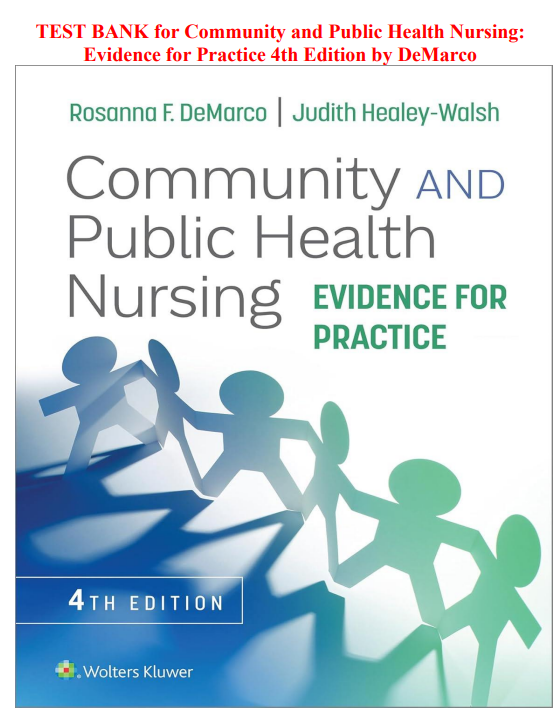
This test bank is built around the 4th edition of Community and Public Health Nursing: Evidence for Practice by Rosanna DeMarco. It follows the textbook chapter by chapter, so your study sessions actually match your course outline.
Whether you’re finishing a BSN program, working through an RN-to-BSN bridge, or taking a standalone community health course, this resource helps you apply population-level thinking to real-world scenarios.
What This Test Bank Covers
DeMarco’s textbook blends theory with evidence-based practice, and this test bank follows that same structure. You’ll find questions covering:
- Foundations and history of public health nursing
- Epidemiology and the epidemiologic triangle
- Environmental health and safety
- Community assessment and windshield surveys
- Health promotion and disease prevention models
- Vulnerable and underserved populations
- Cultural competence and health disparities
- Communicable disease control
- Disaster preparedness and emergency response
- Policy, advocacy, and health care financing
- Home health, hospice, and school nursing roles
If your course covers it, there’s a strong chance this test bank has questions on it.
Why This Test Bank Stands Out
1. It Follows the Textbook’s Actual Structure
You won’t dig through unrelated content. Questions are organized to match the chapters in the 4th edition, so review stays focused and efficient.
2. It Tests Population-Level Thinking
Community health exams don’t ask about a single patient’s vital signs. They ask you to think about aggregates, risk factors, and prevention levels. This test bank was built with that exact lens.
3. Every Question Comes With a Rationale
A correct guess doesn’t teach you anything. Each question includes a clear explanation of why the right answer is right, and why the other choices fall short.
4. Simple, Direct Language
Public health has its own vocabulary. Primary, secondary, and tertiary prevention. Epidemiologic triangle. Social determinants of health. This test bank explains these ideas in plain terms, not overly academic language.
5. Fits Any Study Routine
Study a chapter a week through the semester. Or cram before finals. This test bank works either way.
Who This Test Bank Is For
- BSN students taking a community or public health nursing course
- RN-to-BSN students completing bridge coursework
- Nursing instructors building quizzes or exam question pools
- Public health students reviewing nursing-specific content
- Nurses preparing for community health certification exams
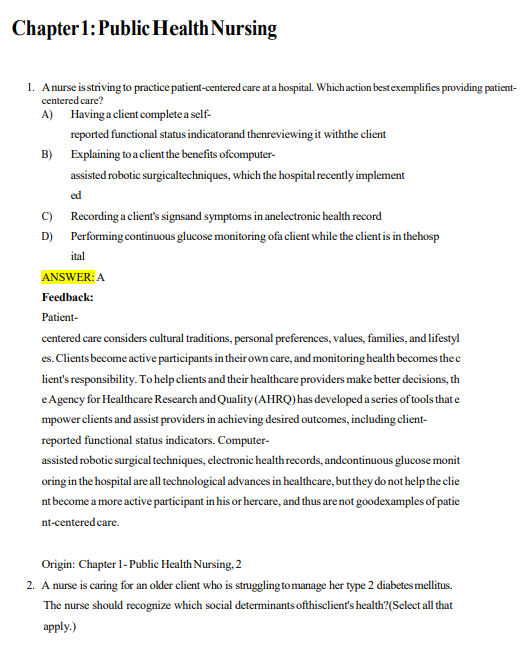
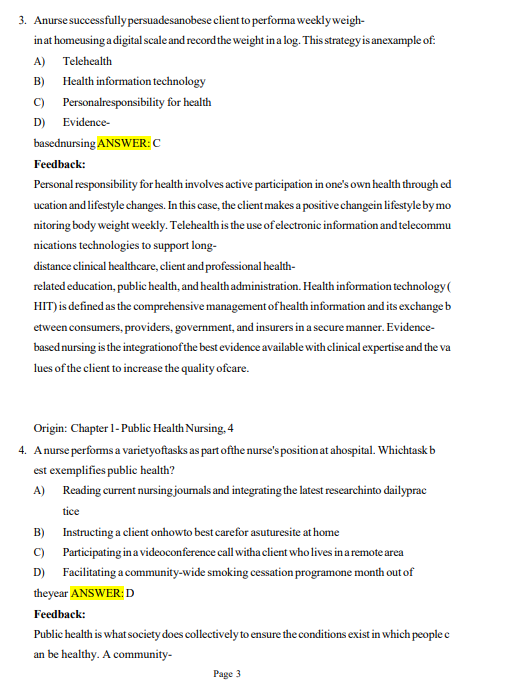
Sample Practice Questions
Here are five sample questions written in the same style and difficulty level as the full test bank.
Question 1: Levels of Prevention
A community health nurse organizes a free flu vaccination clinic for local residents. This action is an example of which level of prevention?
A) Primary prevention
B) Secondary prevention
C) Tertiary prevention
D) Quaternary prevention
Correct Answer: A) Primary prevention
Rationale: Primary prevention aims to stop disease before it starts. Vaccination is a classic example, since it prevents illness rather than detecting or treating it after the fact. Secondary prevention involves early detection, like screening. Tertiary prevention focuses on managing an existing disease to prevent complications. Quaternary prevention isn’t part of the standard three-level model typically taught in this course.
Question 2: Epidemiology
In the epidemiologic triangle, which component refers to the environment that brings the host and agent together?
A) Host
B) Agent
C) Vector
D) Environment
Correct Answer: D) Environment
Rationale: The environment is the external factor that allows the host and agent to interact, such as contaminated water or crowded living conditions. The host is the person or population at risk. The agent is the actual cause of disease, like a bacteria or virus. A vector is an organism that transmits the agent, such as a mosquito, but it isn’t one of the three core points of the epidemiologic triangle.
Question 3: Vulnerable Populations
Which factor is considered a social determinant of health?
A) Blood type
B) Genetic predisposition to disease
C) Access to safe housing
D) Age at diagnosis
Correct Answer: C) Access to safe housing
Rationale: Social determinants of health are the conditions in which people live, work, and grow, including housing, income, education, and access to care. Safe housing directly affects health outcomes and fits this definition. Blood type, genetic predisposition, and age at diagnosis are biological or clinical factors, not social or environmental conditions.
Question 4: Communicable Disease Control
A community health nurse identifies a cluster of tuberculosis cases in a homeless shelter. What is the nurse’s priority action?
A) Wait for symptoms to worsen before intervening
B) Initiate contact tracing and notify public health authorities
C) Advise residents to seek care only if they feel unwell
D) Disregard the cluster since TB is rarely serious
Correct Answer: B) Initiate contact tracing and notify public health authorities
Rationale: Tuberculosis is a reportable communicable disease, and clusters require prompt contact tracing and notification to public health authorities to prevent further spread. Waiting for symptoms to worsen or advising residents to seek care only if unwell delays necessary intervention. TB can be serious and even fatal without treatment, so disregarding the cluster is never appropriate.
Question 5: Disaster Preparedness
During a mass casualty event, which triage category is assigned to a patient with a threatened airway who requires immediate intervention?
A) Minor, or “walking wounded”
B) Delayed
C) Immediate
D) Expectant
Correct Answer: C) Immediate
Rationale: The immediate category is used for patients with life-threatening injuries, such as an airway compromise, who can be saved with prompt intervention. The minor category covers patients who can wait for care. Delayed applies to serious but non-life-threatening injuries. Expectant is used for patients unlikely to survive even with treatment, given limited resources during a mass casualty event.
These five questions are just a small preview. The full test bank includes a much larger set of questions covering every chapter of the 4th edition.
How to Study With This Test Bank
- Match your review to your course schedule. Study chapters in the order your instructor assigns them.
- Pay close attention to the rationales. Public health nursing exams reward understanding of concepts like prevention levels and social determinants, not just memorized facts.
- Practice thinking at the population level. If a question is about one patient, ask yourself how the same concept applies to a whole community.
- Revisit missed questions after a few days. Spaced review helps information stick for the long term.
- Use this alongside your textbook readings. The test bank reinforces the material; it isn’t a replacement for it.
Why This Beats Generic Practice Quizzes
Free quizzes online often use inconsistent terminology or skip topics your course actually tests on. This test bank was built specifically around DeMarco’s 4th edition, so the wording, structure, and depth line up with your actual exams.
Format and Delivery
This test bank is delivered as a digital file. You get access right after purchase. No shipping. No delays. Study from your laptop, tablet, or phone whenever it’s convenient.
Frequently Asked Questions
Is this test bank the same as the textbook?
No. This is a companion study resource. You’ll still need Community and Public Health Nursing: Evidence for Practice, 4th Edition, for full chapter content and case studies.
Does this cover epidemiology topics?
Yes. Epidemiologic concepts, including the epidemiologic triangle and levels of prevention, are covered extensively.
Is this useful for RN-to-BSN students?
Yes. Community health courses are common in bridge programs, and this test bank aligns closely with that coursework.
Can instructors use this to build exams?
Yes. Many instructors use test banks like this as a starting point for quizzes, midterms, or final exams.
What question formats are included?
You’ll find multiple choice, true or false, matching, and short answer questions throughout.
Are rationales included with the answers?
Yes. Every question includes an explanation of why the correct answer is right and why the other choices aren’t.
Does this cover disaster preparedness content?
Yes. Triage principles, emergency response, and disaster planning are all represented in the question set.
How is this different from the textbook’s built-in review questions?
Built-in review questions are usually limited in number. This test bank offers a much larger, more comprehensive set with detailed rationales for deeper practice.
Final Thoughts
Community and public health nursing asks you to zoom out. To think beyond one patient and consider entire populations, systems, and environments. This test bank for the 4th edition of Community and Public Health Nursing: Evidence for Practice gives you a direct way to practice that broader thinking. Realistic scenarios. Clear explanations. A study tool built around the exact course you’re taking.
Grab your copy today and prepare with real confidence.
Alan Kuqi –
Questions feel relevant and practical
Lisa Horton –
Great resource for nursing students.
Even Njeri –
Helpful explanations after each question
Kamara Reid –
Questions provide helpful reinforcement of important nursing principles
Lucas Gabriel –
Easy to navigate and convenient for studying anywhere.