Psychiatric nursing asks you to think differently than most other nursing courses. There’s no lab value to check or wound to assess. Instead, you’re reading tone, body language, and what a patient isn’t saying out loud. That’s a hard skill to study for using flashcards alone. This test bank was built to help.
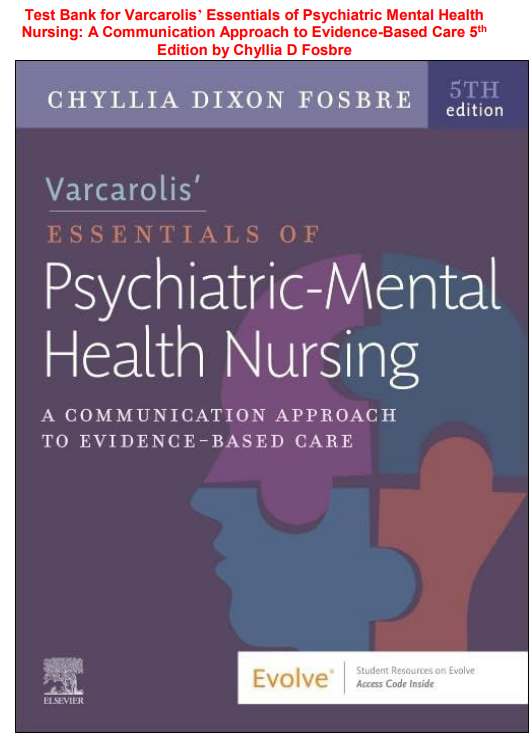
It follows the 5th edition of Varcarolis’ Essentials of Psychiatric Mental Health Nursing: A Communication Approach to Evidence-Based Care by Chyllia D. Fosbre, chapter by chapter. So your review sessions actually match what your instructor is covering that week.
Whether you’re in a BSN program, an accelerated nursing track, or reviewing for a psych clinical rotation, this resource helps you connect theory to the kind of judgment calls you’ll actually face at the bedside.
What This Test Bank Covers
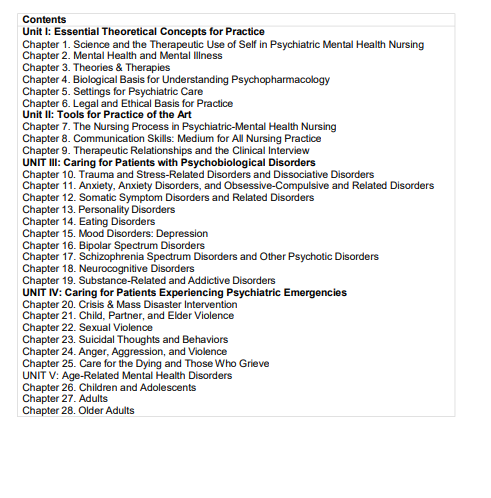
Varcarolis has long been a go-to text because it blends communication technique with clinical content. This test bank mirrors that same balance. You’ll find questions on:
- Therapeutic communication and the nurse-patient relationship
- Legal and ethical issues in psychiatric care
- Anxiety, obsessive-compulsive, and trauma-related disorders
- Mood disorders, including depression and bipolar disorder
- Schizophrenia and other psychotic disorders
- Personality disorders
- Substance use disorders
- Eating disorders
- Crisis intervention and suicide risk assessment
- Psychopharmacology basics
- Grief, loss, and end-of-life care
- Child, adolescent, and older adult mental health
If it’s in the textbook, there’s a strong chance this test bank has a question on it.
Why This Test Bank Stands Out
1. It Follows the Textbook’s Structure
Every question lines up with a specific chapter in the 5th edition. That means less time hunting for relevant material and more time actually reviewing it.
2. It Tests Communication Skills, Not Just Facts
A lot of the value in this course comes from knowing what to say, and what not to say, to a patient in distress. This test bank includes scenario-based questions that mirror that exact skill.
3. Every Question Has a Rationale
Getting an answer right by chance doesn’t teach you much. Each question explains why the correct choice is right and why the other options miss the mark.
4. Plain Language Throughout
Psychiatric terminology can get heavy fast. This test bank keeps sentence structure simple, so the concept stays front and center instead of getting buried in jargon.
5. Works With Any Study Pace
Review one disorder category a night. Or push through several chapters before a big exam. This test bank adjusts to your schedule.
Who This Test Bank Is For
- Nursing students taking a psychiatric mental health nursing course
- Students preparing for a psych clinical rotation
- RN-to-BSN students completing bridge coursework
- Nursing instructors building quizzes or exam question pools
- Nurses reviewing psychiatric content before certification exams
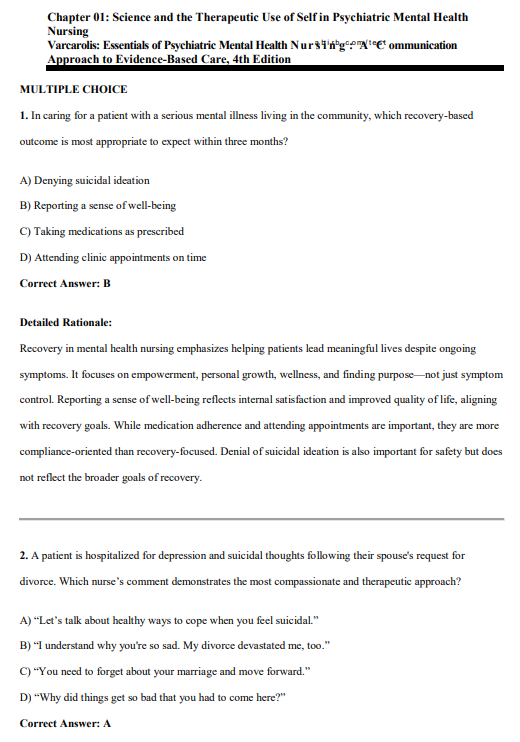
Sample Practice Questions
Here are five sample questions written in the same style and difficulty level as the full test bank.
Question 1: Therapeutic Communication
A patient says, “I feel like nobody cares about me.” Which response by the nurse demonstrates the most effective therapeutic communication technique?
A) “That’s not true, your family visits you every day.”
B) “It sounds like you’re feeling really alone right now.”
C) “Why would you think that? You have plenty of support.”
D) “Let’s talk about something more positive instead.”
Correct Answer: B) “It sounds like you’re feeling really alone right now.”
Rationale: This response uses reflection, a therapeutic technique that acknowledges the patient’s feelings without judgment or dismissal. It opens the door for the patient to keep talking. Option A dismisses the patient’s feelings by arguing facts. Option C asks a “why” question, which can feel confrontational and shut down communication. Option D avoids the patient’s emotional state entirely, which discourages honest expression.
Question 2: Suicide Risk Assessment
A patient with a history of depression tells the nurse, “I have a plan and I know exactly how I’d do it.” What is the nurse’s priority action?
A) Document the statement and continue the assessment later
B) Ask the patient to promise not to act on the plan
C) Immediately notify the treatment team and initiate safety precautions
D) Change the subject to reduce the patient’s distress
Correct Answer: C) Immediately notify the treatment team and initiate safety precautions
Rationale: A specific, detailed plan indicates high suicide risk and requires immediate action to keep the patient safe. Notifying the treatment team and starting safety precautions takes priority over anything else. Delaying documentation, relying on a “no-suicide contract” style promise, or changing the subject all fail to address the immediate danger and can leave the patient without needed protection.
Question 3: Mood Disorders
Which symptom is most characteristic of the manic phase of bipolar disorder?
A) Excessive sleep and fatigue
B) Decreased need for sleep with increased energy
C) Persistent feelings of worthlessness
D) Loss of interest in previously enjoyed activities
Correct Answer: B) Decreased need for sleep with increased energy
Rationale: During a manic episode, patients often feel rested after very little sleep and show a noticeable increase in energy, activity, and impulsivity. Excessive sleep, worthlessness, and loss of interest are more consistent with a depressive episode, not mania.
Question 4: Schizophrenia
A patient with schizophrenia tells the nurse, “The television is sending me secret messages.” How should the nurse best respond?
A) “You’re wrong, the television can’t send you messages.”
B) “I understand that seems real to you, but I don’t hear any messages.”
C) “What kind of messages is it sending you?”
D) “Let’s turn off the television so it stops.”
Correct Answer: B) “I understand that seems real to you, but I don’t hear any messages.”
Rationale: This response validates the patient’s experience as real to them without reinforcing the delusion as factual. It’s honest and maintains trust. Telling the patient they’re “wrong” can feel confrontational and damage rapport. Asking for details about the message content can reinforce the delusion. Turning off the television doesn’t address the underlying delusional thinking and may not reduce the patient’s distress.
Question 5: Substance Use Disorders
A patient who regularly drinks alcohol is admitted for an unrelated surgery. Which finding should the nurse monitor for as an early sign of alcohol withdrawal?
A) Bradycardia and hypotension
B) Tremors, anxiety, and elevated heart rate
C) Excessive sleepiness
D) Decreased body temperature
Correct Answer: B) Tremors, anxiety, and elevated heart rate
Rationale: Early alcohol withdrawal typically presents with autonomic hyperactivity, including tremors, anxiety, sweating, and an elevated heart rate, often starting within hours of the last drink. Bradycardia, hypotension, excessive sleepiness, and decreased body temperature are the opposite of what’s expected and could suggest a different problem entirely.
These five questions are just a small sample. The full test bank includes a much larger question set spanning every chapter of the 5th edition.
How to Study With This Test Bank
- Match your review to your syllabus. Study disorder categories in the order your course covers them.
- Read every rationale, even for questions you get right. Psychiatric nursing exams reward reasoning, not just memorized answers.
- Pay close attention to communication-style questions. These show up often and require careful reading of tone and wording.
- Revisit missed questions after a few days. Spaced repetition helps concepts stick for exam day and for clinicals.
- Pair this with your assigned textbook chapters. The test bank reinforces the material; it isn’t meant to replace it.
Why This Beats Generic Practice Quizzes
Free psych nursing quizzes online often use different terminology or skip content your course actually tests on. This test bank was built specifically around Fosbre’s 5th edition, so the wording, structure, and difficulty match what you’ll see on your real exams.
Format and Delivery
This test bank is delivered as a digital file. You get access immediately after purchase. No shipping. No delays. Study from your laptop, tablet, or phone whenever you have time.
Frequently Asked Questions
Is this test bank the same as the textbook?
No. This is a companion study resource. You’ll still need Varcarolis’ Essentials of Psychiatric Mental Health Nursing: A Communication Approach to Evidence-Based Care, 5th Edition, for full chapter content and case studies.
Does this include communication-style scenario questions?
Yes. Therapeutic communication is a core focus of the textbook, and this test bank reflects that with realistic patient-response scenarios.
Is this useful for clinical rotation prep?
Yes. Many students use test banks like this to review before starting a psychiatric clinical rotation.
Can instructors use this to build exams?
Yes. Instructors and TAs often use test banks like this as a foundation for quizzes, midterms, or final exams.
What question formats are included?
You’ll find multiple choice, true or false, matching, and short answer questions throughout.
Are rationales included for every answer?
Yes. Each question comes with an explanation covering why the correct answer is right and why the other choices are incorrect.
Does this cover psychopharmacology?
Yes. Basic medication classes and their relevance to psychiatric conditions are included, though this isn’t a dedicated pharmacology resource.
How is this different from the textbook’s built-in review questions?
Built-in chapter review questions are usually limited in number. This test bank offers a much larger, more comprehensive set with detailed rationales for deeper practice.
Final Thoughts
Psychiatric mental health nursing asks you to slow down and really listen. It’s about reading a patient’s words and what’s underneath them. This test bank for the 5th edition of Varcarolis’ Essentials of Psychiatric Mental Health Nursing gives you a direct way to practice that skill before your exam. Realistic scenarios. Clear explanations. A study tool built around the exact course you’re taking.
Grab your copy today and prepare with real confidence.
Rosemary R –
Good mix of challenging questions.
Ivy N. –
Perfect for last-minute studying
Mary Kesh –
Definitely worth adding to your study routine
Liam Mbogo –
Made studying more focused and productive
Thomas K. –
Questions were helpful for reviewing important clinical concepts.
Anne Johnson –
Questions encourage careful thinking about course concepts.
Andy Sole –
Useful material for building a consistent practice schedule.
Francis Pelosi –
A practical resource for reviewing specific learning objectives
Kai Marcus –
Helpful exercises for testing recall after lectures.