Caring for older adults isn’t just medical-surgical nursing with more gray hair in the room. Aging changes how the body responds to disease, medication, and treatment. It also changes how a provider needs to think. That’s exactly what this textbook, and this test bank, are built around.
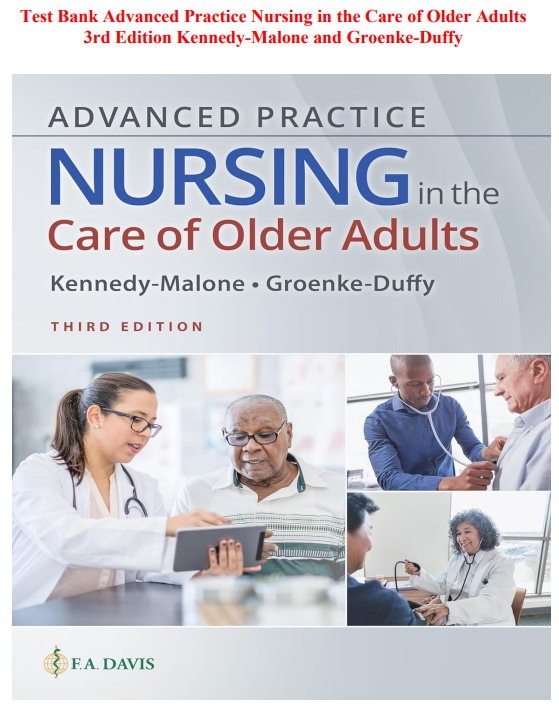
This test bank follows the 3rd edition of Advanced Practice Nursing in the Care of Older Adults by Laurie Kennedy-Malone and Evelyn Groenke-Duffy, chapter by chapter. So your review sessions actually track with what your program is teaching.
Whether you’re an NP student, a DNP student, or a practicing advanced practice nurse specializing in geriatrics, this resource sharpens the clinical reasoning skills that matter most when treating older patients.
What This Test Bank Covers
This textbook is built specifically for the advanced practice role, and this test bank reflects that scope. You’ll find questions on:
- Normal physiologic changes of aging across body systems
- Comprehensive geriatric assessment
- Polypharmacy and medication management in older adults
- Cognitive disorders, including dementia and delirium
- Frailty, falls, and functional decline
- Cardiovascular and respiratory conditions in older adults
- Endocrine and metabolic changes with aging
- Musculoskeletal and sensory changes
- Palliative care and end-of-life decision-making
- Elder abuse and mistreatment recognition
- Legal, ethical, and reimbursement issues in geriatric care
- Health promotion and disease prevention for aging populations
If it’s a focus of the textbook, there’s a strong chance it’s covered here.
Why This Test Bank Stands Out
1. It Mirrors the Textbook’s Organization
Questions are grouped to match the chapters of the 3rd edition, so you can move straight to the section you’re currently studying without wading through unrelated material.
2. It’s Built for Advanced Practice Thinking
This isn’t an entry-level nursing test bank. Questions are written at the level of clinical decision-making expected from a nurse practitioner, including diagnosis, treatment planning, and medication management specific to older adults.
3. Every Question Comes With a Rationale
An answer without an explanation doesn’t build clinical judgment. Each question breaks down why the correct choice fits best and why the other options fall short in an older adult population.
4. Straightforward, Focused Language
Geriatric pharmacology and assessment content can get dense fast. This test bank keeps the wording clear so the clinical reasoning stays front and center.
5. Useful for Long-Term, Repeated Review
Geriatric-specific knowledge, like adjusted drug dosing or atypical disease presentation, benefits from repeated exposure. This test bank is built with that kind of ongoing review in mind.
Who This Test Bank Is For
- Nurse practitioner students in adult-gerontology or family NP tracks
- DNP students focused on geriatric or primary care
- Advanced practice nurses preparing for gerontological certification
- Nursing faculty building quizzes or exam question pools
- Practicing NPs and PAs refreshing geriatric-specific knowledge
Sample Practice Questions
Here are five sample questions written in the same style and difficulty level as the full test bank.
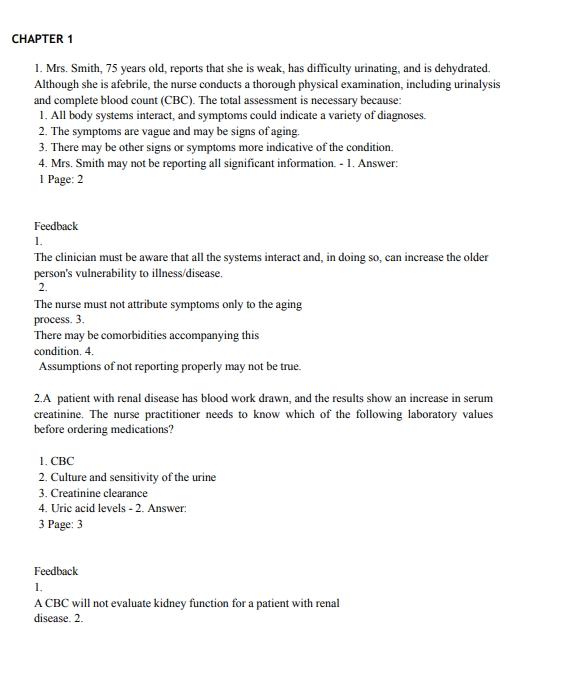
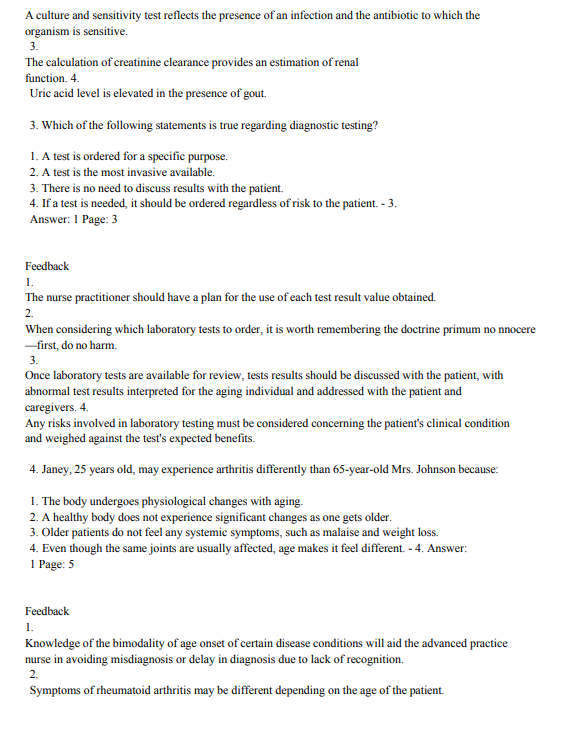
Question 1: Physiologic Changes of Aging
Which age-related change most directly increases an older adult’s risk for medication toxicity?
A) Increased hepatic blood flow
B) Decreased renal clearance
C) Increased gastric motility
D) Increased total body water
Correct Answer: B) Decreased renal clearance
Rationale: Renal function naturally declines with age, which slows the clearance of many medications and increases the risk of drug accumulation and toxicity. Hepatic blood flow typically decreases with age, not increases. Gastric motility often slows rather than speeds up. Total body water usually decreases with age as well, which can actually raise concentrations of water-soluble drugs rather than diluting them.
Question 2: Cognitive Disorders
An 82-year-old patient develops sudden confusion, fluctuating attention, and disorganized thinking over the course of a single day. Which condition should the nurse practitioner suspect first?
A) Alzheimer’s disease
B) Delirium
C) Vascular dementia
D) Normal age-related forgetfulness
Correct Answer: B) Delirium
Rationale: Delirium has a sudden onset and fluctuating course, often triggered by an underlying medical issue like infection or medication effect. Alzheimer’s disease and vascular dementia both develop gradually over months or years, not within a single day. Normal age-related forgetfulness doesn’t involve disorganized thinking or fluctuating attention, making it inconsistent with this presentation.
Question 3: Polypharmacy
Which action best reflects appropriate medication management for an older adult on multiple prescriptions?
A) Automatically renewing all medications at each visit without review
B) Reviewing the full medication list at every visit and deprescribing when appropriate
C) Avoiding new medications regardless of clinical need
D) Relying solely on the patient’s memory of what they take
Correct Answer: B) Reviewing the full medication list at every visit and deprescribing when appropriate
Rationale: Regular medication review helps identify unnecessary, duplicate, or high-risk medications, which reduces adverse drug events in older adults. Deprescribing when appropriate is a core part of safe geriatric prescribing. Automatically renewing medications without review misses opportunities to catch problems. Avoiding all new medications isn’t practical or safe if a new condition requires treatment, and relying only on patient memory risks missing important details, especially in patients with cognitive changes.
Question 4: Falls and Frailty
Which finding during a geriatric assessment is most concerning for increased fall risk?
A) Normal gait speed for age
B) Use of four or more prescription medications
C) Independent in all activities of daily living
D) Normal vision without correction needed
Correct Answer: B) Use of four or more prescription medications
Rationale: Polypharmacy, generally defined as taking four or more medications, is a well-established risk factor for falls in older adults, due to side effects like dizziness, sedation, and orthostatic hypotension. Normal gait speed, independence in daily activities, and normal vision are all protective factors rather than risk factors, and their presence would actually lower overall fall risk.
Question 5: Palliative and End-of-Life Care
An older adult with advanced heart failure tells the nurse practitioner she wants to focus on comfort rather than aggressive treatment. What is the most appropriate next step?
A) Continue aggressive treatment since the patient may change her mind
B) Initiate a conversation about advance directives and palliative care options
C) Avoid discussing end-of-life care to prevent distressing the patient
D) Refer the patient to a specialist without addressing her stated wishes
Correct Answer: B) Initiate a conversation about advance directives and palliative care options
Rationale: Respecting patient autonomy means acknowledging her stated goals and opening a conversation about advance directives and palliative care resources that align with her wishes. Continuing aggressive treatment against her stated preference disregards her autonomy. Avoiding the conversation entirely fails to support informed decision-making, and referring her out without addressing her wishes first delays care that should begin with the provider she’s already talking to.
These five questions are just a small sample. The full test bank includes a much larger question set spanning every chapter of the 3rd edition.
How to Study With This Test Bank
- Match your review to your course sequence. Study body systems and topics in the order your program covers them.
- Pay close attention to pharmacology-related rationales. Medication management in older adults is a heavily tested area and often differs from adult-population norms.
- Practice distinguishing delirium, dementia, and depression. These three conditions overlap in presentation and show up often on exams.
- Revisit missed questions after a few days. Spaced review helps geriatric-specific nuances stick for the long term.
- Pair this with your assigned textbook chapters. The test bank reinforces the material; it isn’t meant to replace it.
Why This Beats Generic Geriatric Practice Quizzes
Generic online quizzes are often written for general nursing audiences, not advanced practice students. This test bank was built specifically around Kennedy-Malone and Groenke-Duffy’s 3rd edition, so the depth, terminology, and clinical reasoning level match what you’ll actually face in your program and future practice.
Format and Delivery
This test bank is delivered as a digital file. You get instant access after purchase. No shipping. No delays. Study from your laptop, tablet, or phone whenever it’s convenient.
Frequently Asked Questions
Is this test bank the same as the textbook?
No. This is a companion study resource. You’ll still need Advanced Practice Nursing in the Care of Older Adults, 3rd Edition, for full chapter content and case discussions.
Is this appropriate for entry-level nursing students?
Not really. This test bank is written at an advanced practice level, so it’s best suited for NP, DNP, or advanced practice students rather than pre-licensure nursing students.
Does this cover pharmacology specific to older adults?
Yes. Polypharmacy, deprescribing, and age-related medication considerations are covered extensively throughout the question set.
Can faculty use this to build course exams?
Yes. Many faculty members use test banks like this as a foundation for quizzes, midterms, or final exams in advanced practice programs.
What question formats are included?
You’ll find multiple choice, true or false, matching, and short answer questions throughout.
Are rationales included for every answer?
Yes. Each question includes an explanation of why the correct answer fits best in an older adult population.
Is this useful for gerontological certification exam prep?
Yes. The content aligns closely with concepts tested on gerontological nurse practitioner certification exams.
How is this different from the textbook’s built-in review questions?
Built-in review questions are usually limited in number. This test bank offers a much larger, more comprehensive question set with detailed rationales for deeper practice.
Final Thoughts
Caring for older adults takes a different kind of clinical thinking, one that accounts for how aging changes disease presentation, medication response, and overall risk. This test bank for the 3rd edition of Advanced Practice Nursing in the Care of Older Adults gives you a direct way to build that thinking before your exam. Realistic scenarios. Honest explanations. A study tool built around the exact patient population you’ll be treating.
Grab your copy today and prepare with real confidence.

Peterson S. –
Great study tool for reinforcing difficult concepts
Kamara Reid –
Explanations make reviewing incorrect answers easier
Rosemary R –
Very useful for NCLEX-style practice and preparation
Winnie M. –
Outstanding resource for nursing exam success.
Bruno Molino –
Great resource for practicing nursing exam questions
Beverly –
Reliable and effective study resource
Lucas Gabriel –
Improved my gero nursing knowledge quickly