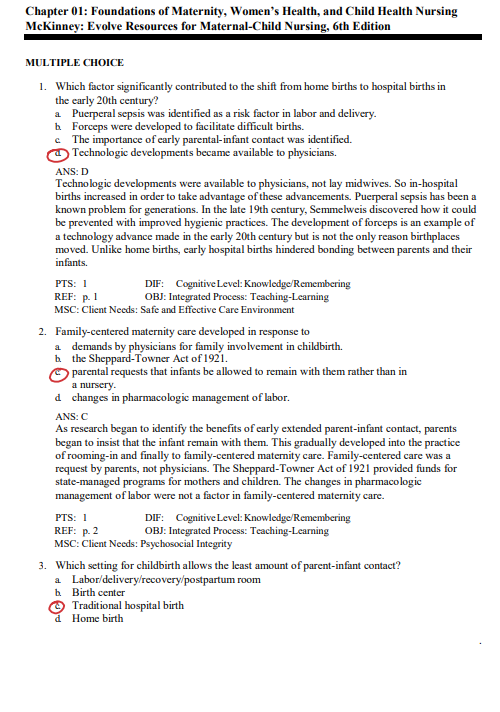
Maternal-child nursing asks you to think about two patients at once, sometimes three if you count the whole family unit. Pregnancy, birth, and childhood development all move fast, and the margin for error is often smaller than in other specialties. That combination makes this one of the more demanding courses in a nursing program, and one where solid practice really pays off.
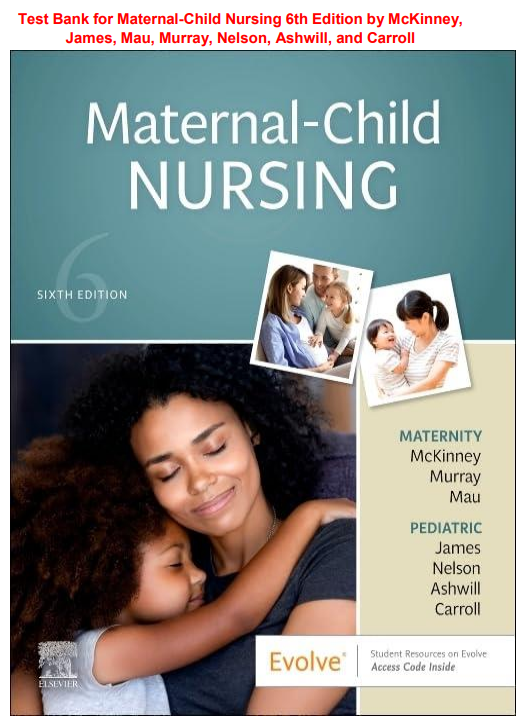
This test bank is built around the 6th edition of Maternal-Child Nursing by McKinney, James, Mau, Murray, Ashwill, and Gorrie. It follows the textbook unit by unit, so your review sessions actually match your course schedule.
Whether you’re in a traditional BSN program, an accelerated track, or reviewing before an OB or peds clinical rotation, this resource helps you connect assessment findings to safe, timely nursing action.
What This Test Bank Covers
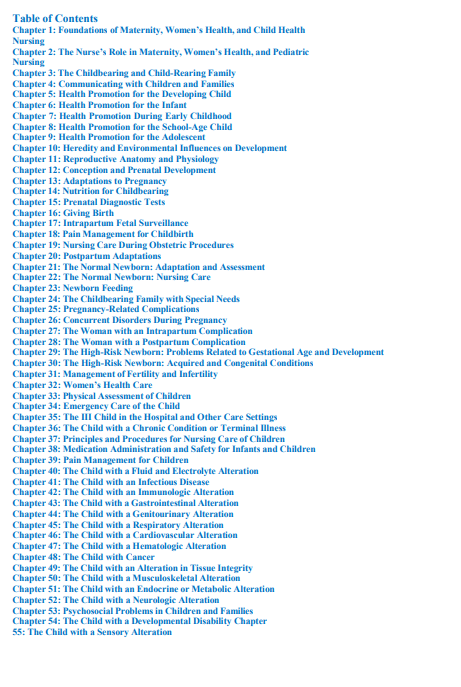
McKinney’s textbook spans the full continuum from conception through adolescence, and this test bank reflects that same range. You’ll find questions covering:
- Reproductive anatomy and physiology
- Conception, fetal development, and genetics
- Prenatal care and maternal adaptations to pregnancy
- Antepartum complications and high-risk pregnancy
- Labor and birth, including fetal monitoring
- Intrapartum complications and obstetric emergencies
- Postpartum physiology and nursing care
- Postpartum complications
- Normal newborn care and assessment
- High-risk and ill newborn care
- Growth and development across childhood
- Pediatric health promotion and family-centered care
- Acute and chronic childhood illnesses
- Pediatric emergencies and hospitalized child care
If it’s a chapter in the textbook, there’s a strong chance it’s represented in this test bank.
Why This Test Bank Stands Out
1. It Follows the Textbook’s Structure
Every question lines up with a specific unit in the 6th edition, whether that’s antepartum care or pediatric growth and development. That keeps review targeted instead of scattered.
2. It Covers Both Sides of the Course
Maternal-child nursing blends two distinct populations, and a lot of study resources lean too heavily one way. This test bank gives equal attention to maternal-newborn content and pediatric content, matching the textbook’s own balance.
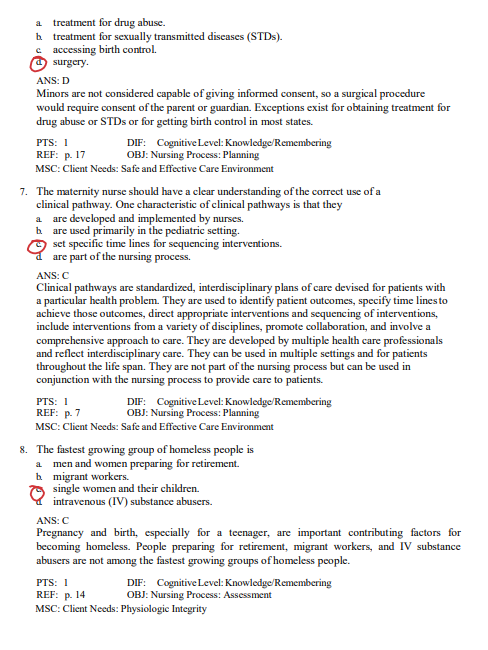
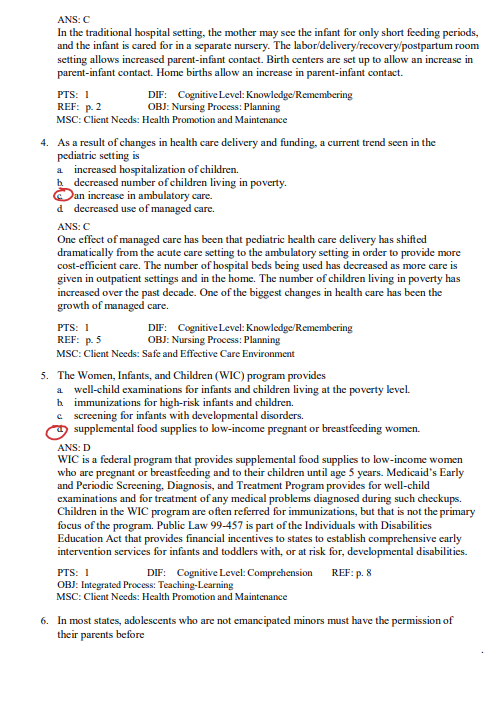
3. Every Question Comes With a Rationale
Getting a question right by chance doesn’t teach you the underlying reasoning. Each question explains why the correct answer is right and why the other choices don’t fit the clinical picture.
4. Clear, Direct Language
Maternal-child content covers a lot of ground quickly, from labor stages to pediatric milestones. This test bank keeps sentence structure simple so the concept stays easy to follow.
5. Works With Any Study Schedule
Review one unit a week through the semester, or push through several units before a big exam. This test bank adjusts either way.
Who This Test Bank Is For
- Nursing students taking a Maternal-Child or Obstetric and Pediatric Nursing course
- Accelerated BSN students moving through content quickly
- Students preparing for OB or peds clinical rotations
- Nursing instructors building quizzes or exam question pools
- New graduate nurses reviewing before starting a women’s or children’s unit
Sample Practice Questions
Here are five sample questions written in the same style and difficulty level as the full test bank.
Question 1: Antepartum Care
A pregnant patient at 28 weeks gestation reports a headache, visual disturbances, and swelling in her hands and face. Blood pressure is 158/102 mmHg. Which condition should the nurse suspect first?
A) Gestational diabetes
B) Preeclampsia
C) Placenta previa
D) Normal third-trimester discomfort
Correct Answer: B) Preeclampsia
Rationale: Elevated blood pressure combined with headache, visual disturbances, and edema after 20 weeks gestation is a classic presentation of preeclampsia, a hypertensive disorder of pregnancy that requires prompt evaluation. Gestational diabetes doesn’t typically cause these specific symptoms. Placenta previa presents with painless vaginal bleeding rather than hypertension and visual changes. These findings are well outside the range of normal third-trimester discomfort and shouldn’t be dismissed as such.
Question 2: Intrapartum Care
During labor, a fetal heart rate monitor shows a pattern of late decelerations. What is the nurse’s priority action?
A) Continue routine monitoring with no changes
B) Reposition the patient to her left side and notify the provider
C) Increase the rate of oxytocin infusion
D) Document the finding and reassess in one hour
Correct Answer: B) Reposition the patient to her left side and notify the provider
Rationale: Late decelerations suggest uteroplacental insufficiency, meaning the fetus may not be getting adequate oxygen during contractions. Repositioning to the left side improves blood flow to the uterus, and notifying the provider ensures prompt evaluation. Continuing without intervention ignores a potentially concerning pattern. Increasing oxytocin would worsen the problem by intensifying contractions. Waiting an hour to reassess delays necessary action in a situation that calls for immediate response.
Question 3: Postpartum Care
A postpartum patient’s fundus is soft and boggy on assessment, with heavier than expected lochia. What is the nurse’s first action?
A) Notify the provider immediately without further assessment
B) Massage the fundus until firm
C) Have the patient ambulate to the bathroom
D) Apply a heating pad to the lower abdomen
Correct Answer: B) Massage the fundus until firm
Rationale: A soft, boggy fundus indicates uterine atony, a common cause of postpartum hemorrhage. Fundal massage stimulates the uterus to contract, which helps control bleeding and is the appropriate first nursing action. Notifying the provider may still be necessary, but massaging the fundus is the immediate, actionable first step. Ambulating to the bathroom doesn’t address the underlying uterine atony, and a heating pad has no role in managing this situation and could worsen bleeding.
Question 4: Newborn Care
A newborn’s Apgar score at one minute is 4. Which finding is most consistent with this score?
A) Pink body color, strong cry, active movement
B) Blue extremities, slow heart rate, weak cry
C) Heart rate above 100, vigorous cry, good muscle tone
D) Fully pink color with no need for stimulation
Correct Answer: B) Blue extremities, slow heart rate, weak cry
Rationale: An Apgar score of 4 falls in the moderately low range, reflecting a newborn who needs some resuscitative support, which aligns with findings like blue extremities, a slow heart rate, and a weak cry. A newborn with strong color, cry, and movement would score much higher, closer to a normal range of 7 to 10. A heart rate above 100 with vigorous cry and good tone also reflects a higher, healthier score, not a 4.
Question 5: Pediatric Growth and Development
According to Erikson’s stages of psychosocial development, a toddler’s primary developmental task is best described as which of the following?
A) Trust versus mistrust
B) Autonomy versus shame and doubt
C) Initiative versus guilt
D) Industry versus inferiority
Correct Answer: B) Autonomy versus shame and doubt
Rationale: Toddlers, generally ages 1 to 3, are working through Erikson’s stage of autonomy versus shame and doubt, marked by a growing desire for independence in activities like toileting and dressing. Trust versus mistrust applies to infancy. Initiative versus guilt applies to the preschool years. Industry versus inferiority applies to school-age children, making these stages inconsistent with a toddler’s current developmental task.
These five questions only scratch the surface. The full test bank includes hundreds of similar questions spanning every unit of the 6th edition.
How to Study With This Test Bank
- Study maternal-newborn and pediatric content separately at first. These sections require different knowledge bases, so give each its own focused review before mixing them together.
- Read every rationale carefully. Maternal-child exams often test prioritization and early recognition of complications, not just textbook definitions.
- Practice recognizing red-flag findings. Late decelerations, boggy fundi, and abnormal Apgar scores show up often and require quick recognition.
- Revisit missed questions after a few days. Spaced repetition helps fast-moving clinical content stay accessible for the long term.
- Pair this with your assigned textbook chapters. The test bank reinforces the material; it isn’t meant to replace it.
Why This Beats Generic Maternal-Child Quizzes
Free quizzes online often blur maternal and pediatric content together without matching your course’s actual structure or depth. This test bank was built specifically around the 6th edition by McKinney and colleagues, so the terminology, structure, and difficulty match exactly what you’ll see on your real exams.
Format and Delivery
This test bank is delivered as a digital file. You get instant access after purchase. No shipping. No delays. Study from your laptop, tablet, or phone whenever you have time.
Frequently Asked Questions
Is this test bank the same as the textbook?
No. This is a companion study resource. You’ll still need Maternal-Child Nursing, 6th Edition, for full chapter content, images, and detailed case discussions.
Does this cover both obstetric and pediatric content?
Yes. The test bank mirrors the textbook’s full scope, spanning prenatal care through adolescent development.
Is this useful for NCLEX prep?
It can be. Maternal-child concepts, especially prioritization and early complication recognition, show up frequently on licensure exams, so this practice supports that broader preparation.
Can instructors use this to build exams?
Yes. Many instructors use test banks like this as a foundation for quizzes, unit exams, or finals.
What question formats are included?
You’ll find multiple choice, true or false, matching, and short answer questions throughout the set.
Are rationales included for every question?
Yes. Each question comes with an explanation of why the correct answer is right and why the other choices are incorrect.
Is this helpful before starting an OB or peds clinical rotation?
Yes. Many students use resources like this to review core concepts before applying them in a clinical setting.
How is this different from the textbook’s built-in review questions?
Built-in chapter review questions are usually limited in number. This test bank offers a much larger, more comprehensive question set with detailed rationales for deeper practice.
Final Thoughts
Maternal-child nursing moves fast and asks you to think about more than one patient at a time. This test bank for the 6th edition of Maternal-Child Nursing gives you a direct way to build that quick, layered clinical thinking before your exam. Realistic scenarios. Honest explanations. A study tool built around the exact patients you’ll be caring for.
Grab your copy today and study with real confidence.

Reviews
There are no reviews yet.