Nursing research is the course a lot of students dread and then quietly realize they actually need. It’s not about running your own study. It’s about reading someone else’s study and knowing whether to trust it. That skill shows up constantly in real practice, every time a new treatment or protocol gets proposed. This test bank was built to help that skill click sooner rather than later.
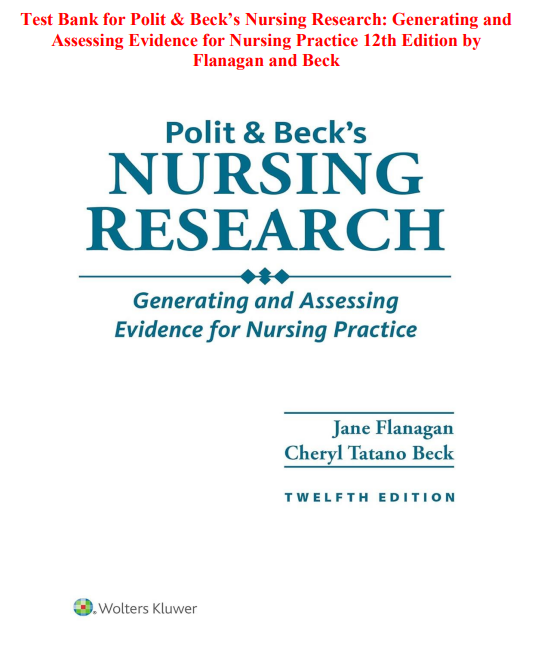
It follows the 12th edition of Polit & Beck’s Nursing Research: Generating and Assessing Evidence for Nursing Practice by Jane Flanagan and Cheryl Tatano Beck, chapter by chapter. So your review sessions actually match your course structure.
Whether you’re in an undergraduate research course, a graduate program building EBP competency, or reviewing before a research-heavy certification exam, this resource sharpens the exact reasoning this subject demands.
What This Test Bank Covers
Polit & Beck’s textbook is considered the standard reference for nursing research education, and this test bank mirrors its full scope. You’ll find questions covering:
- Foundations of evidence-based practice
- Quantitative research design and methods
- Qualitative research design and methods
- Sampling strategies and sample size considerations
- Reliability and validity in measurement
- Data collection methods
- Statistical analysis and interpretation basics
- Systematic reviews and meta-analysis
- Research ethics and protection of human subjects
- Critiquing published research studies
- Translating research findings into clinical practice
If it’s a chapter in the textbook, there’s a strong chance it’s represented in this test bank.
Why This Test Bank Stands Out
1. It Follows the Textbook’s Structure
Every question aligns with a specific chapter in the 12th edition, so review stays organized instead of scattered across unrelated research concepts.
2. It Builds Critical Appraisal Skills
Nursing research exams rarely ask you to just define a term like “reliability.” They ask you to evaluate whether a specific study design actually supports its conclusions. This test bank was built with that same applied, evaluative style in mind.
3. Every Question Comes With a Rationale
A correct guess doesn’t teach you how to appraise research. Each question explains why the correct answer is right and why the other choices fall short, especially for design and methodology questions where the distinctions can be subtle.
4. Clear, Accessible Language
Research methodology terminology can feel dense fast. This test bank keeps sentence structure simple so the underlying concept stays the focus, not the vocabulary.
5. Useful for Both Undergraduate and Graduate Review
Whether your course covers the basics of EBP or dives deep into statistical interpretation, this test bank spans that full range.
Who This Test Bank Is For
- BSN students taking a nursing research or evidence-based practice course
- RN-to-BSN students completing bridge coursework
- MSN and DNP students building research appraisal skills
- Nursing instructors building quizzes or exam question pools
- Nurses preparing for research-related certification content
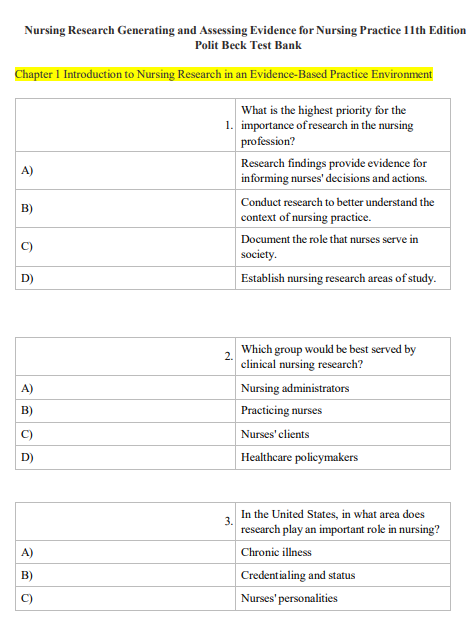
Sample Practice Questions
Here are five sample questions written in the same style and difficulty level as the full test bank.
Question 1: Research Design
A researcher randomly assigns patients to either a new wound care protocol or the standard protocol, then compares healing times. Which research design does this represent?
A) Case study
B) Randomized controlled trial
C) Descriptive study
D) Qualitative phenomenological study
Correct Answer: B) Randomized controlled trial
Rationale: Random assignment of participants to an intervention group and a comparison group is the defining feature of a randomized controlled trial, which is considered a strong design for establishing cause-and-effect relationships. A case study examines a single individual or small group in depth without random assignment. A descriptive study simply observes and describes characteristics without manipulating any variable. A qualitative phenomenological study explores lived experiences and doesn’t involve random assignment or numerical comparison.
Question 2: Reliability and Validity
A pain scale consistently produces the same score when the same patient is measured twice within a short time period, with no change in actual pain level. This demonstrates which measurement property?
A) Content validity
B) Test-retest reliability
C) Construct validity
D) Criterion validity
Correct Answer: B) Test-retest reliability
Rationale: Test-retest reliability refers to the consistency of a measurement tool when used repeatedly under the same conditions. Getting the same score across repeated measurements, with no true change in the underlying condition, demonstrates this consistency. Content validity refers to whether a tool covers the full range of a concept. Construct validity refers to whether a tool truly measures the theoretical concept it claims to measure. Criterion validity compares a tool’s results to another established standard, none of which describe repeated consistency over time.
Question 3: Sampling
A researcher recruits participants for a study on rare genetic disorders by asking initial participants to refer other people with the same condition. Which sampling method does this describe?
A) Simple random sampling
B) Convenience sampling
C) Snowball sampling
D) Stratified random sampling
Correct Answer: C) Snowball sampling
Rationale: Snowball sampling relies on existing study participants referring other potential participants, which is especially useful for reaching small or hard-to-find populations, like people with a rare condition. Simple random sampling requires every member of a population to have an equal chance of selection, which isn’t the case here. Convenience sampling involves recruiting whoever is easiest to reach, without the referral chain described. Stratified random sampling divides a population into subgroups before random selection, which doesn’t match this recruitment method either.
Question 4: Research Ethics
Which action best reflects the ethical principle of beneficence in a nursing research study?
A) Ensuring all participants understand the study before consenting
B) Maximizing possible benefits and minimizing possible harm to participants
C) Distributing study benefits and burdens fairly across all participants
D) Allowing participants to withdraw from the study at any time
Correct Answer: B) Maximizing possible benefits and minimizing possible harm to participants
Rationale: Beneficence specifically refers to maximizing benefit and minimizing harm to research participants. Ensuring understanding before consent relates to the principle of respect for persons and informed consent. Fair distribution of benefits and burdens describes the principle of justice. Allowing withdrawal at any time is a component of voluntary participation, tied to respect for persons rather than beneficence specifically.
Question 5: Evidence-Based Practice
When appraising a research study for potential use in practice, which factor is most important in determining whether findings can be applied to a specific patient population?
A) The study’s sample size alone
B) Whether the study population closely resembles the intended patient population
C) The number of citations the study has received
D) Whether the study was published in the last five years
Correct Answer: B) Whether the study population closely resembles the intended patient population
Rationale: Applicability to practice depends heavily on how closely the study’s sample matches the population a nurse intends to apply the findings to, since results may not generalize well across very different groups. Sample size alone doesn’t guarantee applicability if the population differs significantly. Citation count reflects a study’s influence or visibility, not its relevance to a specific clinical population. Publication date matters for currency but doesn’t by itself determine whether findings transfer appropriately to a different patient group.
These five questions only scratch the surface. The full test bank includes hundreds of similar questions spanning every chapter of the 12th edition.
How to Study With This Test Bank
- Study research design and methodology together. These concepts build on each other, so reviewing them side by side helps the distinctions stick.
- Focus on the differences between similar terms. Reliability versus validity, and the different types of sampling, are common points of confusion that show up often on exams.
- Read every rationale carefully. Research courses reward the ability to explain why a design or method fits a scenario, not just recognize a definition.
- Practice applying concepts to short scenarios. Since real exam questions often use brief study descriptions, this test bank’s scenario-based format mirrors that structure.
- Revisit missed questions after a few days. Spaced repetition helps methodology-heavy content stay accessible for the long term.
Why This Beats Generic Research Methods Quizzes
Free research methods quizzes online are often written for general social science students, not nursing-specific practice. This test bank was built specifically around the 12th edition by Flanagan and Beck, so the terminology, structure, and examples match exactly what a nursing research course expects.
Format and Delivery
This test bank is delivered as a digital file. You get instant access after purchase. No shipping. No delays. Study from your laptop, tablet, or phone whenever you have time.
Frequently Asked Questions
Is this test bank the same as the textbook?
No. This is a companion study resource. You’ll still need Polit & Beck’s Nursing Research: Generating and Assessing Evidence for Nursing Practice, 12th Edition, for full chapter content and detailed methodology explanations.
Does this cover both quantitative and qualitative research?
Yes. Both research traditions are represented throughout the question set, matching the textbook’s dual coverage.
Is this useful for graduate-level EBP courses?
Yes. While the content spans undergraduate fundamentals, it also supports graduate students building more advanced critical appraisal skills.
Can instructors use this to build course exams?
Yes. Many instructors use test banks like this as a foundation for quizzes, midterms, or final exams.
What question formats are included?
You’ll find multiple choice, true or false, matching, and short answer questions throughout the set.
Are rationales included for every question?
Yes. Each question comes with an explanation of why the correct answer is right and why the other choices don’t fit.
Does this cover statistical concepts?
Yes. Basic statistical analysis and interpretation are included, though this isn’t a dedicated biostatistics resource.
How is this different from the textbook’s built-in review questions?
Built-in review questions are usually limited in number. This test bank offers a much larger, more comprehensive question set with detailed rationales for deeper practice.
Final Thoughts
Nursing research asks you to become a more critical reader, someone who can look at a published study and know whether its findings deserve a place in real patient care. This test bank for the 12th edition of Polit & Beck’s Nursing Research gives you a direct way to build that skill before your exam. Realistic scenarios. Honest explanations. A study tool built around the exact reasoning your course is training you to use.
Grab your copy today and study with real confidence.
Alicia Silva –
Made difficult topics easier to review
Kamara Reid –
Useful for identifying gaps in my knowledge.
Liam Mbogo –
Questions provided excellent preparation for exams.
Thomas K. –
Straightforward format made studying convenient.
Kevin May –
Very very useful as I prepare for my tests
Perpetual Gates –
Perfect study guide for every nursing research student.
Lucas Gabriel –
Helpful tool for checking my understanding.
SHoustone –
Questions were challenging but still understandable.
Terence V. –
Great resource for focused exam preparation
Ava Reed –
A useful way to turn revision into a daily habit.
Leah Kiptum –
Questions provide a quick checkpoint after finishing each chapter.
Jaqueline M. –
Helpful material for practicing recall before reviewing notes.