Pulmonary function testing is one of those subjects that looks straightforward on paper and gets complicated fast in practice. Flow-volume loops, spirometry values, diffusion capacity, all of it requires precision. One misread number can change a diagnosis. That’s why this course demands more than passive reading. It demands practice.
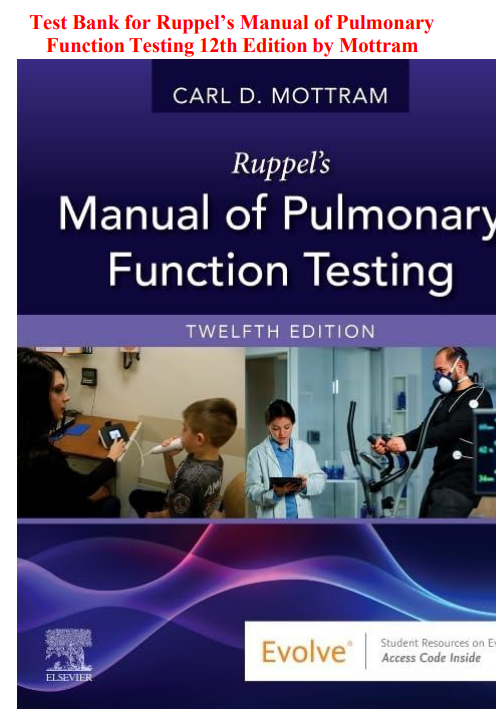
This test bank is built around the 12th edition of Ruppel’s Manual of Pulmonary Function Testing by Carl A. Mottram. It follows the textbook chapter by chapter, so your review lines up directly with what your program is teaching.
Whether you’re a respiratory therapy student, a pulmonary function tech in training, or reviewing before a credentialing exam, this resource helps you build accuracy and confidence with test interpretation.
What This Test Bank Covers
Ruppel’s manual is considered a core reference in respiratory care education, and this test bank mirrors its full scope. You’ll find questions on:
- Basic pulmonary anatomy and physiology as it relates to testing
- Spirometry procedures and interpretation
- Lung volumes and capacities
- Diffusing capacity (DLCO) testing
- Bronchoprovocation and bronchodilator response testing
- Blood gas analysis and interpretation
- Cardiopulmonary exercise testing
- Infection control and equipment calibration
- Quality control and test standardization
- Pediatric and specialized testing considerations
- Interpretation strategies for obstructive and restrictive patterns
If it’s covered in the textbook, there’s a strong chance it’s represented in this test bank.
Why This Test Bank Stands Out
1. It Follows the Textbook Chapter by Chapter
You won’t waste time sifting through unrelated material. Every question is organized to match the structure of the 12th edition, so your review stays targeted.
2. It Focuses on Interpretation, Not Just Terminology
Knowing the definition of FEV1 is one thing. Knowing what a reduced FEV1/FVC ratio means for a specific patient is another. This test bank leans into that applied, clinical style of thinking.
3. Every Question Comes With a Rationale
A right answer without an explanation doesn’t build lasting knowledge. Each question breaks down why the correct choice is right and why the other options don’t hold up.
4. Clear, No-Nonsense Language
Pulmonary function testing already comes with plenty of technical vocabulary. This test bank keeps sentence structure simple, so the underlying concept stays easy to follow.
5. Useful for Repeated Review
Test interpretation is a skill that improves with repetition. This test bank is built for multiple passes, not just a single readthrough before an exam.
Who This Test Bank Is For
- Respiratory therapy students in an accredited program
- Pulmonary function technologists in training
- Students preparing for the CRT or RRT credentialing exams
- Instructors building quizzes or exam question pools
- Practicing clinicians refreshing PFT interpretation skills
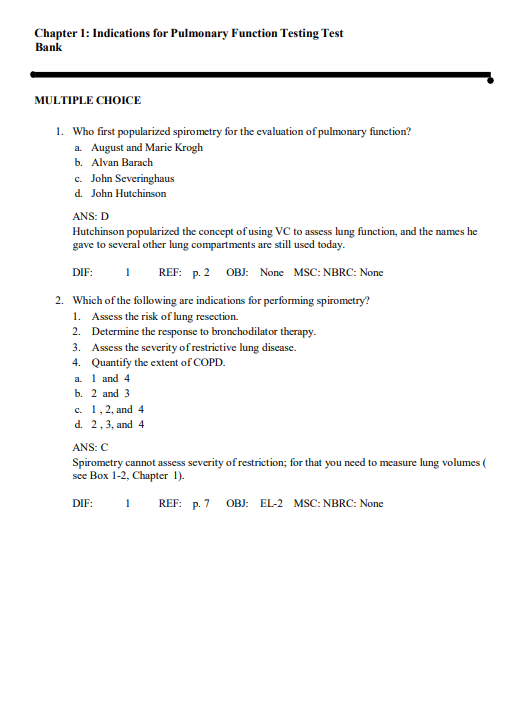
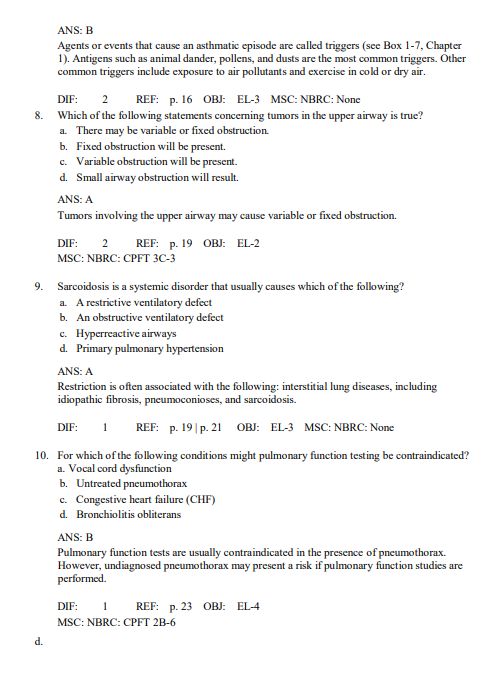
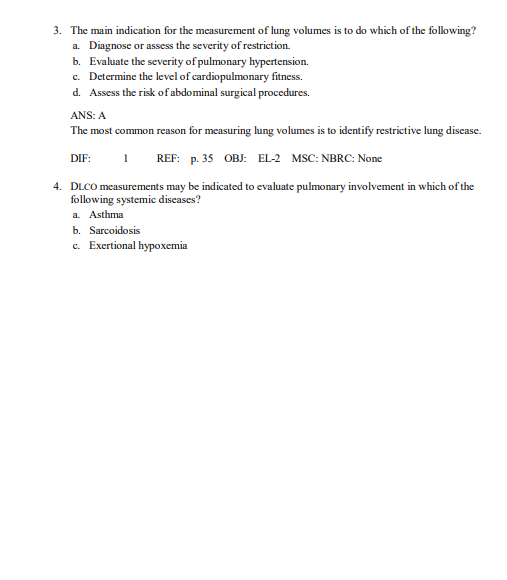
Sample Practice Questions
Here are five sample questions written in the same style and difficulty level as the full test bank.
Question 1: Spirometry Interpretation
A patient’s spirometry results show a reduced FEV1/FVC ratio with a normal FVC. Which pattern does this most likely indicate?
A) Restrictive lung disease
B) Obstructive lung disease
C) Mixed obstructive and restrictive disease
D) Normal lung function
Correct Answer: B) Obstructive lung disease
Rationale: A reduced FEV1/FVC ratio with a normal or near-normal FVC is the classic pattern of obstructive lung disease, since airflow out of the lungs is limited while overall lung volume remains relatively preserved. Restrictive disease typically shows a reduced FVC with a normal or increased FEV1/FVC ratio. A mixed pattern would show both a reduced ratio and a reduced FVC, and normal lung function wouldn’t produce a reduced ratio at all.
Question 2: Lung Volumes
Which lung volume cannot be measured directly using spirometry alone and requires body plethysmography or gas dilution testing instead?
A) Tidal volume
B) Inspiratory reserve volume
C) Residual volume
D) Expiratory reserve volume
Correct Answer: C) Residual volume
Rationale: Residual volume is the air remaining in the lungs after a maximal exhalation, and since it can’t be exhaled, spirometry alone can’t measure it. Body plethysmography or gas dilution methods, like helium dilution or nitrogen washout, are needed instead. Tidal volume, inspiratory reserve volume, and expiratory reserve volume are all measurable directly through spirometry, since they involve volumes of air that are actually inhaled or exhaled.
Question 3: Diffusing Capacity
A patient with emphysema is most likely to show which finding on DLCO testing?
A) Increased diffusing capacity
B) Decreased diffusing capacity
C) Normal diffusing capacity with reduced lung volumes
D) DLCO results unaffected by emphysema
Correct Answer: B) Decreased diffusing capacity
Rationale: Emphysema destroys alveolar walls and the surrounding capillary network, which reduces the surface area available for gas exchange. This leads to a decreased DLCO. Conditions like asthma typically don’t affect DLCO significantly, but emphysema’s structural damage makes reduced diffusing capacity a hallmark finding.
Question 4: Bronchodilator Response
After bronchodilator administration, a patient’s FEV1 improves by 15% and 220 mL. How should this result be interpreted?
A) No significant response to bronchodilator
B) A significant, positive bronchodilator response
C) An inconclusive result requiring repeat testing
D) A sign of worsening airway obstruction
Correct Answer: B) A significant, positive bronchodilator response
Rationale: A positive bronchodilator response is generally defined as an improvement in FEV1 of at least 12% and 200 mL from baseline. This patient’s results exceed both thresholds, indicating a significant, positive response. This finding is often used to help distinguish reversible airway obstruction, as seen in asthma, from more fixed obstruction patterns.
Question 5: Blood Gas Interpretation
A patient’s arterial blood gas shows a pH of 7.30, PaCO2 of 55 mmHg, and HCO3 of 24 mEq/L. Which condition does this represent?
A) Uncompensated respiratory acidosis
B) Uncompensated metabolic acidosis
C) Compensated respiratory alkalosis
D) Compensated metabolic alkalosis
Correct Answer: A) Uncompensated respiratory acidosis
Rationale: The low pH indicates acidosis, and the elevated PaCO2 points to a respiratory cause. Since the HCO3 level remains within normal range, the kidneys haven’t yet compensated for the elevated CO2, making this uncompensated respiratory acidosis. Metabolic acidosis would show a low HCO3 rather than a normal one, and neither alkalosis option fits, since the pH here is below 7.35, not above 7.45.
These five questions only scratch the surface. The full test bank includes hundreds of questions spanning every chapter of the 12th edition.
How to Study With This Test Bank
- Study one testing category at a time. Spirometry, lung volumes, diffusing capacity, and blood gases each deserve focused attention before moving to the next.
- Read every rationale carefully. Interpretation skills are built through understanding the reasoning, not memorizing isolated numbers.
- Practice pattern recognition. Obstructive versus restrictive versus mixed patterns show up constantly, so drilling that distinction pays off.
- Revisit missed questions after a few days. Spaced repetition strengthens recall better than reviewing the same material back to back.
- Pair this with hands-on lab practice. The test bank reinforces theory, but real interpretation skill also comes from working with actual tracings and reports.
Why This Beats Generic Practice Quizzes
Free respiratory therapy quizzes online often use inconsistent reference values or skip content specific to your course. This test bank was built specifically around Mottram’s 12th edition, so the terminology, structure, and interpretation standards match what you’ll see in your actual program and exams.
Format and Delivery
This test bank is delivered as a digital file. You get instant access after purchase. No shipping. No delays. Study from your laptop, tablet, or phone whenever you have time.
Frequently Asked Questions
Is this test bank the same as the textbook?
No. This is a companion study resource. You’ll still need Ruppel’s Manual of Pulmonary Function Testing, 12th Edition, for full explanations, reference tracings, and detailed procedural content.
Does this cover blood gas interpretation?
Yes. Arterial blood gas analysis is included, since it’s closely tied to pulmonary function assessment in the textbook.
Is this useful for CRT or RRT exam prep?
Yes. Pulmonary function testing concepts show up on respiratory therapy credentialing exams, so this practice supports that broader preparation.
Can instructors use this to build exams?
Yes. Many instructors use test banks like this as a starting point for quizzes, midterms, or final exams.
What question formats are included?
You’ll find multiple choice, true or false, matching, and short answer questions throughout the set.
Are rationales included for every question?
Yes. Every question comes with an explanation of why the correct answer is right and why the other choices fall short.
Is this appropriate for pulmonary function technologists, not just respiratory therapy students?
Yes. Anyone working with or training in pulmonary function testing can benefit from this resource, regardless of exact job title.
How is this different from the textbook’s built-in review questions?
Built-in review questions are usually limited in number. This test bank offers a much larger, more comprehensive question set with detailed rationales for deeper practice.
Final Thoughts
Pulmonary function testing rewards precision. A misread ratio or a missed pattern can change how a patient’s condition gets understood and treated. This test bank for the 12th edition of Ruppel’s Manual of Pulmonary Function Testing gives you a direct way to build that precision before your exam. Realistic questions. Clear explanations. A study tool built around the exact skill this course is testing.
Grab your copy today and study with real confidence.


Winnie M. –
Useful practice bank with a good question variety.
Lucas Gabriel –
Definitely improved my confidence before exam day
Yunice M –
Great supplement to my nursing study routine
Caleb Martins –
Questions encourage critical thinking and clinical reasoning
Beverly –
Convenient resource for daily nursing practice
Liam Mbogo –
Convenient way to review before an upcoming exam.
Karen Njiru –
Useful review exercises for strengthening long-term recall.
Romy Cleo –
A practical option for testing knowledge chapter by chapter.
Lucille Maria –
Helpful questions for connecting theory with course content.