Pharmacology courses cover a huge number of drug classes, and it’s easy to lose the thread between one chapter and the next. Lehne’s approach helps by grouping drugs around body systems and prototype agents, so once you understand one representative drug in a class, the rest of that class starts to make sense too. This test bank was built to reinforce exactly that kind of learning.
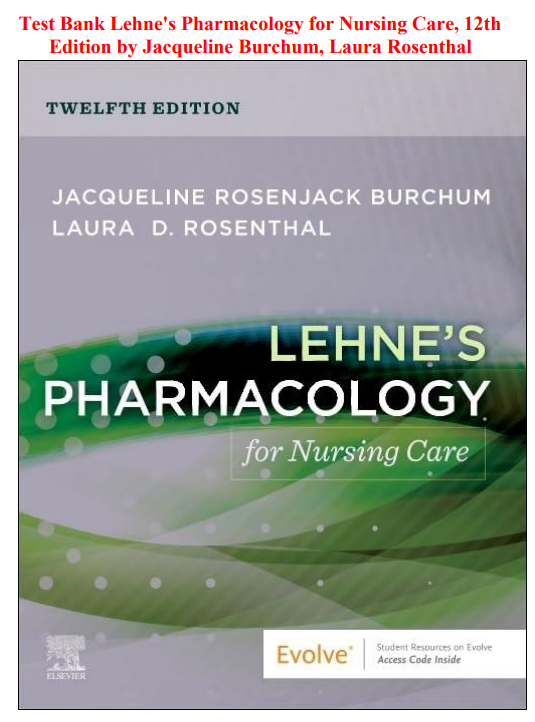
It follows the 12th edition of Lehne’s Pharmacology for Nursing Care by Jacqueline Rosenjack Burchum and Laura D. Rosenthal, unit by unit. So your review sessions actually match your course structure, whether you’re moving through central nervous system drugs, cardiovascular agents, or anti-infectives.
Whether you’re in an ADN, BSN, or accelerated nursing program, this resource strengthens both your understanding of how drugs work and your ability to apply that knowledge at the bedside.
What This Test Bank Covers
Lehne’s textbook spans the full scope of nursing pharmacology, and this test bank mirrors that same range. You’ll find questions on:
- Basic pharmacology principles, including pharmacokinetics and pharmacodynamics
- Drug therapy across the life span, including pregnancy, pediatrics, and older adults
- Peripheral and central nervous system drugs
- Psychotherapeutic agents and substance use disorders
- Drugs for fluid and electrolyte balance
- Cardiovascular, hematologic, and endocrine medications
- Reproductive health medications
- Anti-inflammatory, antiallergic, and immunologic drugs
- Bone, joint, and respiratory medications
- Gastrointestinal drugs and nutrition-related therapies
- Antimicrobial, antiviral, and antifungal agents
- Cancer chemotherapy and toxicology
If it’s a chapter in the textbook, there’s a strong chance it’s represented in this test bank.
Why This Test Bank Stands Out
1. It Follows the Textbook’s Structure
Every question aligns with a specific chapter in the 12th edition. That means faster, more focused review instead of digging through content unrelated to your current unit.
2. It Reinforces the Prototype Drug Approach
Lehne’s textbook is built around representative prototype drugs for each class, so understanding one drug helps you understand the whole family. This test bank was written with that same learning strategy in mind.
3. Every Question Comes With a Rationale
A correct guess doesn’t build lasting pharmacology knowledge. Each question explains why the correct answer is right and why the other choices don’t hold up.
4. Clear, Direct Language
Pharmacology already comes with a heavy vocabulary load. This test bank keeps sentence structure simple so the mechanism or nursing consideration stays the focus.
5. Built for Repeated Review
Drug classes and their nursing implications benefit from repeated exposure over a semester, not a single cram session. This test bank supports that kind of ongoing practice.
Who This Test Bank Is For
- ADN and BSN students taking a dedicated pharmacology course
- Accelerated nursing students moving through drug content quickly
- Students preparing for dosage and pharmacology competency exams
- Nursing instructors building quizzes or exam question pools
- Nurses refreshing pharmacology knowledge before returning to practice
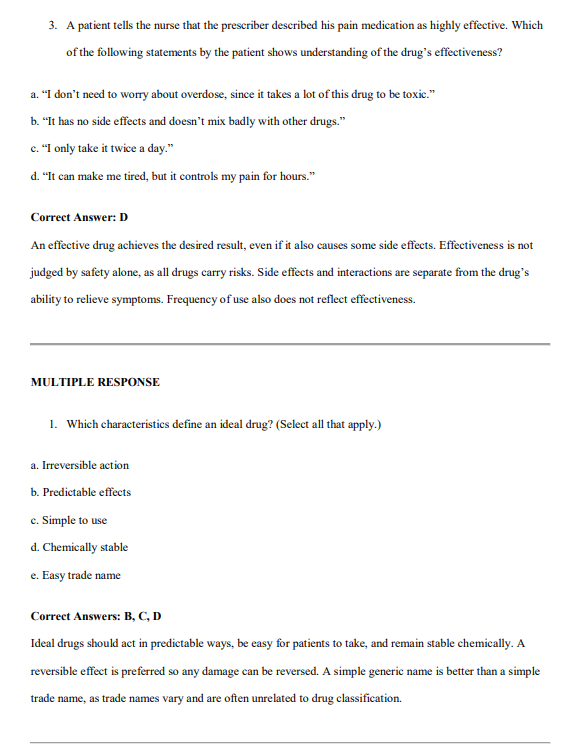
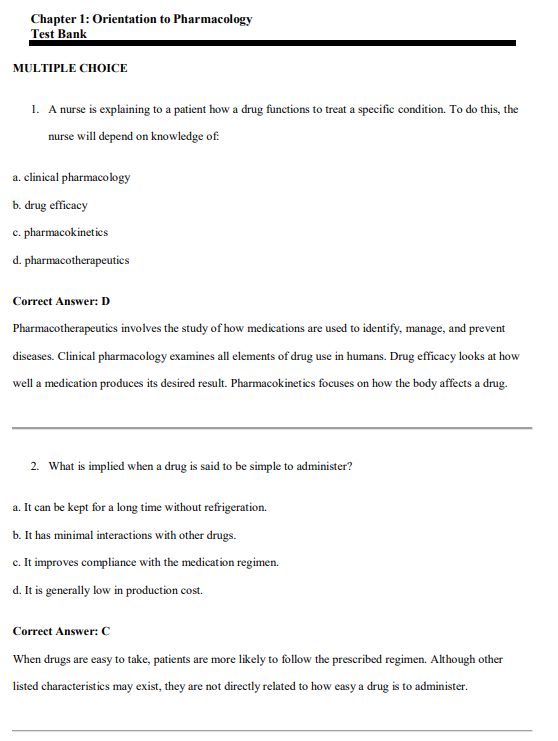
Sample Practice Questions
Here are five sample questions written in the same style and difficulty level as the full test bank.
Question 1: Adrenergic Drugs
A patient receiving an alpha-1 adrenergic agonist for hypotension should be monitored closely for which effect?
A) Bronchodilation
B) Reflex bradycardia
C) Hypoglycemia
D) Decreased blood pressure
Correct Answer: B) Reflex bradycardia
Rationale: Alpha-1 agonists cause vasoconstriction, which raises blood pressure. In response, the body’s baroreceptor reflex often slows the heart rate to compensate, producing reflex bradycardia. Bronchodilation is more associated with beta-2 activation, not alpha-1. Hypoglycemia isn’t a typical effect of alpha-1 stimulation, and blood pressure rises with this drug class rather than decreasing.
Question 2: Drugs for Heart Failure
Which finding would indicate a therapeutic response to a diuretic in a patient with heart failure?
A) Weight gain of two pounds in one day
B) Decreased urine output
C) Reduced peripheral edema and weight loss
D) Increased crackles in the lungs
Correct Answer: C) Reduced peripheral edema and weight loss
Rationale: Diuretics reduce fluid overload in heart failure, so a positive response includes decreased edema and gradual weight loss as excess fluid is eliminated. Weight gain, decreased urine output, and worsening crackles all point to fluid retention, which is the opposite of what a diuretic should achieve.
Question 3: Opioid Analgesics
A patient receiving an opioid analgesic for postoperative pain develops a respiratory rate of 8 breaths per minute. What is the nurse’s priority action?
A) Administer the next scheduled opioid dose as ordered
B) Encourage the patient to cough and deep breathe
C) Withhold the next dose and notify the provider
D) Document the finding and reassess in four hours
Correct Answer: C) Withhold the next dose and notify the provider
Rationale: A respiratory rate of 8 breaths per minute indicates significant respiratory depression, a serious and potentially life-threatening opioid side effect. The nurse should withhold further opioid doses and notify the provider immediately. Giving another dose would worsen the depression. Coughing and deep breathing won’t reverse opioid-induced respiratory depression, and waiting four hours to reassess risks further decline.
Question 4: Anticoagulant Therapy
A patient taking warfarin has an INR of 5.8. Which action should the nurse anticipate?
A) Increasing the warfarin dose
B) Administering vitamin K as ordered
C) Encouraging a high-vitamin-K diet
D) Continuing the current dose without changes
Correct Answer: B) Administering vitamin K as ordered
Rationale: An INR of 5.8 is significantly elevated above the typical therapeutic range and indicates an increased bleeding risk. Vitamin K is the antidote used to help reverse warfarin’s effects when the INR is too high. Increasing the dose or continuing without changes would raise bleeding risk further. A high-vitamin-K diet is generally discouraged during warfarin therapy since it can interfere with the drug’s action, but that’s a long-term dietary consideration, not the immediate response to a critically high INR.
Question 5: Antimicrobial Therapy
A patient is prescribed an antibiotic from the penicillin class. Before administration, which assessment is most important for the nurse to complete?
A) Checking the patient’s most recent blood glucose level
B) Asking about any known allergies to penicillin or related antibiotics
C) Reviewing the patient’s most recent chest X-ray
D) Assessing the patient’s joint range of motion
Correct Answer: B) Asking about any known allergies to penicillin or related antibiotics
Rationale: Allergic reactions to penicillin can range from mild rash to life-threatening anaphylaxis, so confirming allergy history is a critical safety step before administration. Blood glucose, chest X-ray results, and joint range of motion aren’t directly relevant to the immediate safety concerns of administering a penicillin-class antibiotic.
These five questions only scratch the surface. The full test bank includes hundreds of similar questions spanning every unit of the 12th edition.
How to Study With This Test Bank
- Study by drug class, not by brand name. Understanding how a whole class works helps you answer questions about unfamiliar medications in that same category.
- Focus on the prototype drug in each chapter. Since the textbook is built around prototypes, mastering the representative agent makes the rest of the class easier to learn.
- Read every rationale carefully. Pharmacology exams reward understanding mechanisms and nursing implications, not just memorized side effects.
- Pay close attention to safety-focused questions. Respiratory depression, bleeding risk, and allergy screening show up often and carry real clinical weight.
- Revisit missed questions after a few days. Spaced repetition helps drug classifications and nursing considerations stick for the long term.
Why This Beats Generic Pharmacology Quizzes
Free pharmacology quizzes online often use inconsistent drug groupings or skip content specific to your course. This test bank was built specifically around Burchum and Rosenthal’s 12th edition, so the terminology, structure, and difficulty match exactly what you’ll see on your real exams.
Format and Delivery
This test bank is delivered as a digital file. You get instant access after purchase. No shipping. No delays. Study from your laptop, tablet, or phone whenever you have a spare few minutes.
Frequently Asked Questions
Is this test bank the same as the textbook?
No. This is a companion study resource. You’ll still need Lehne’s Pharmacology for Nursing Care, 12th Edition, for full chapter content, drug summary tables, and detailed nursing implications.
Does this cover the entire textbook?
Yes. Every unit, from basic pharmacology principles through toxicology, is represented in the question set.
Is this useful for NCLEX prep?
It can be. Pharmacology concepts make up a large portion of licensure exams, so practicing drug classifications and nursing implications here supports that broader preparation.
Can instructors use this to build exams?
Yes. Many instructors use test banks like this as a foundation for quizzes, unit exams, or finals.
What question formats are included?
You’ll find multiple choice, true or false, matching, and short answer questions throughout the set.
Are rationales included for every question?
Yes. Each question comes with an explanation of why the correct answer is right and why the other choices are incorrect.
Does this cover the newer content added in the 12th edition, like transgender health?
Yes. Updated topics reflected in the current edition, including gender-affirming hormone therapy content, are represented in the question set.
How is this different from the textbook’s built-in review questions?
Built-in chapter review questions are usually limited in number. This test bank offers a much larger, more comprehensive question set with detailed rationales for deeper practice.
Final Thoughts
Pharmacology doesn’t have to feel like an endless list of unconnected drug names. Once you understand the prototype approach and the reasoning behind nursing considerations, the subject becomes a lot more manageable. This test bank for the 12th edition of Lehne’s Pharmacology for Nursing Care gives you a direct way to build that understanding before your exam. Realistic questions. Clear explanations. A study tool built around the exact way this course is structured.
Grab your copy today and study with real confidence.
Peris Hart –
Great study tool with realistic practice questions.
Leah Kiptum –
Made studying nursing pharmacology concepts much easier.
Liam Mbogo –
Clear explanations and valuable answer rationales.
SHoustone –
Perfect supplement for nursing pharmacology students preparing for exams.
Rachael M. –
Perfect for reviewing difficult nursing pharmacology concepts.
Mary Lincoln –
Convenient test bank for quick practice.
Terry Anne –
Questions helped me review topics more efficiently.
Marcus R. –
Helpful explanations made difficult questions easier to understand.
Lisa Horton –
Excellent resource for consistent daily practice.
Vmansteain –
Made studying nursing material much more manageable.
Patty Townsend –
Good selection of questions across different topics.