Pharmacology scares a lot of nursing students before they even open the textbook. Drug names blur together. Dosage calculations feel like a math class hiding inside a nursing course. But once the classifications click, and once the math becomes automatic, this subject gets a lot less intimidating. That’s exactly the gap this test bank is built to close.
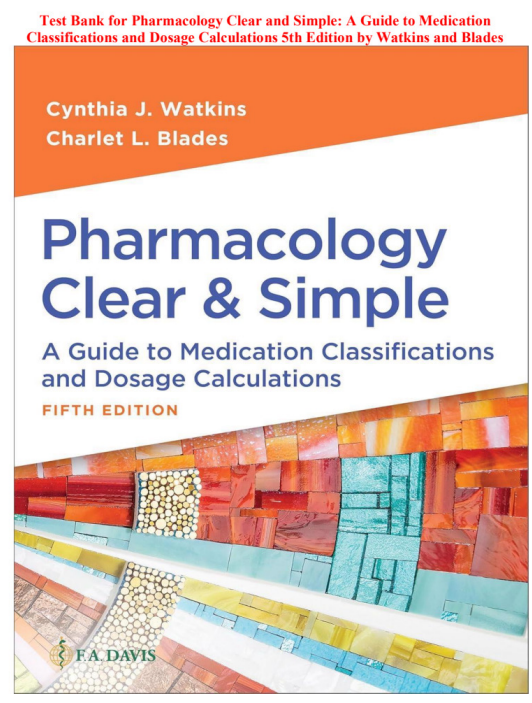
This test bank follows the 5th edition of Pharmacology Clear and Simple: A Guide to Medication Classifications and Dosage Calculations by Cynthia L. Watkins and Jenny Blades, unit by unit. So your review sessions actually match the way your course is structured.
Whether you’re an LPN, ADN, or BSN student, this resource strengthens both sides of pharmacology: knowing what a drug does and knowing how to calculate the dose safely.
What This Test Bank Covers
Watkins and Blades’ textbook is known for breaking pharmacology into manageable, classification-based chunks, and this test bank mirrors that same approach. You’ll find questions covering:
- Basic pharmacology principles and drug legislation
- Dosage calculation methods, including ratio-proportion and dimensional analysis
- Oral, parenteral, and IV medication calculations
- Cardiovascular medications
- Respiratory medications
- Central nervous system medications
- Endocrine and diabetes medications
- Antibiotics and anti-infective agents
- Pain management and analgesics
- Gastrointestinal medications
- Psychiatric medications
- Pediatric and geriatric dosage considerations
If it’s a unit in the textbook, there’s a strong chance it’s represented in this test bank.
Why This Test Bank Stands Out
1. It Follows the Textbook’s Structure
Every question lines up with a specific unit in the 5th edition, whether that’s a drug classification or a calculation method. That keeps review targeted instead of scattered.
2. It Balances Math and Concepts
A lot of pharmacology resources lean heavily one way or the other. This test bank includes both calculation-based questions and classification, action, and side-effect questions, matching the dual focus of the textbook itself.
3. Every Question Comes With a Rationale
Getting a dosage calculation right without understanding the steps doesn’t prepare you for the next problem. Each question explains the reasoning behind the correct answer, whether that’s a calculation method or a drug classification detail.
4. Simple, Direct Language
True to the textbook’s own philosophy, this test bank avoids unnecessary complexity. Explanations are written in plain terms so the core concept is never buried under extra jargon.
5. Built for Repeated Practice
Dosage calculation skills, in particular, improve with repetition. This test bank is designed for multiple passes, not a single readthrough before your exam.
Who This Test Bank Is For
- LPN and LVN students in pharmacology coursework
- ADN and BSN students taking a dedicated pharmacology course
- Nursing students preparing for dosage calculation competency exams
- Nursing instructors building quizzes or exam question pools
- Nurses refreshing calculation and classification knowledge before returning to practice
Sample Practice Questions
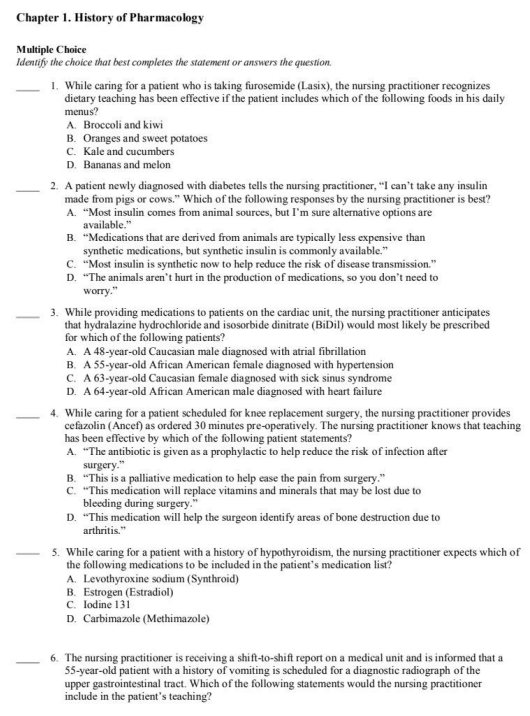
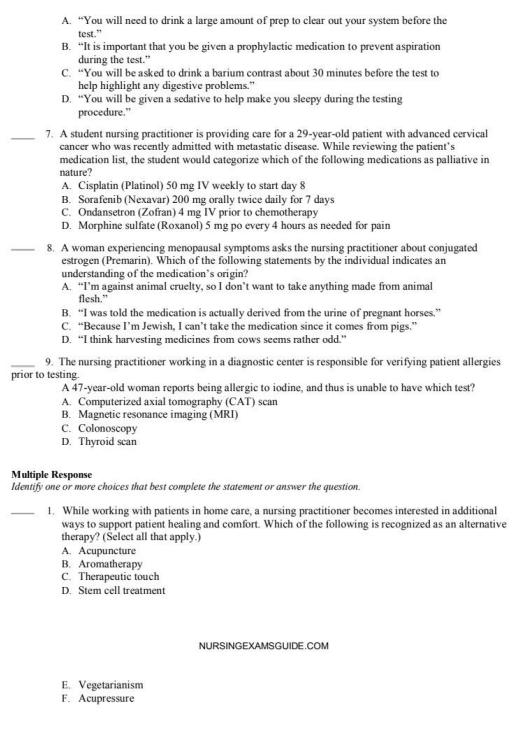
Here are five sample questions written in the same style and difficulty level as the full test bank.
Question 1: Dosage Calculation
A provider orders 500 mg of a medication. The medication is available as 250 mg per 5 mL. How many mL should the nurse administer?
A) 5 mL
B) 10 mL
C) 15 mL
D) 20 mL
Correct Answer: B) 10 mL
Rationale: Using the ratio-proportion method, 250 mg is to 5 mL as 500 mg is to X mL. Cross-multiplying gives 250X equals 2500, so X equals 10 mL. This is double the available concentration’s mg amount, so the volume doubles as well, from 5 mL to 10 mL.
Question 2: Cardiovascular Medications
Which classification of medication works primarily by blocking beta-adrenergic receptors to reduce heart rate and blood pressure?
A) ACE inhibitors
B) Beta blockers
C) Calcium channel blockers
D) Diuretics
Correct Answer: B) Beta blockers
Rationale: Beta blockers work by blocking beta-adrenergic receptors, which reduces heart rate, contractility, and blood pressure. ACE inhibitors work by blocking the conversion of angiotensin I to angiotensin II, a different mechanism entirely. Calcium channel blockers reduce blood pressure by limiting calcium entry into cardiac and vascular smooth muscle cells. Diuretics lower blood pressure by reducing fluid volume, not through receptor blockade.
Question 3: IV Medication Calculation
A patient is ordered 1000 mL of IV fluid to infuse over 8 hours using tubing with a drop factor of 15 gtt/mL. What is the correct flow rate in drops per minute?
A) 21 gtt/min
B) 25 gtt/min
C) 31 gtt/min
D) 35 gtt/min
Correct Answer: C) 31 gtt/min
Rationale: First, calculate the mL per hour: 1000 mL divided by 8 hours equals 125 mL/hr. Then convert to mL per minute: 125 divided by 60 equals approximately 2.08 mL/min. Multiply by the drop factor of 15 gtt/mL, which gives approximately 31.25, rounded to 31 gtt/min. The other answer choices don’t reflect this calculation sequence accurately.
Question 4: Pain Management
Which class of medication carries the highest risk of respiratory depression when administered in excessive doses?
A) Nonsteroidal anti-inflammatory drugs (NSAIDs)
B) Opioid analgesics
C) Acetaminophen
D) Local anesthetics
Correct Answer: B) Opioid analgesics
Rationale: Opioid analgesics act on the central nervous system and can suppress the brain’s respiratory drive, especially at higher doses, making respiratory depression a well-known and serious risk. NSAIDs and acetaminophen don’t carry this same central nervous system depressant effect. Local anesthetics work on nerve conduction at the site of administration and aren’t associated with the same systemic respiratory depression risk when used appropriately.
Question 5: Diabetes Medications
A patient taking metformin should be monitored closely for which potential adverse effect?
A) Hypokalemia
B) Lactic acidosis
C) Hepatotoxicity as the primary concern
D) Hypertension
Correct Answer: B) Lactic acidosis
Rationale: Metformin carries a risk of lactic acidosis, particularly in patients with kidney impairment, since the kidneys are responsible for clearing the medication. This is why kidney function is monitored closely during metformin therapy. Hypokalemia isn’t a typical concern with metformin. While liver function matters for many medications, hepatotoxicity isn’t the primary adverse effect tracked with metformin, and metformin doesn’t cause hypertension as a known side effect.
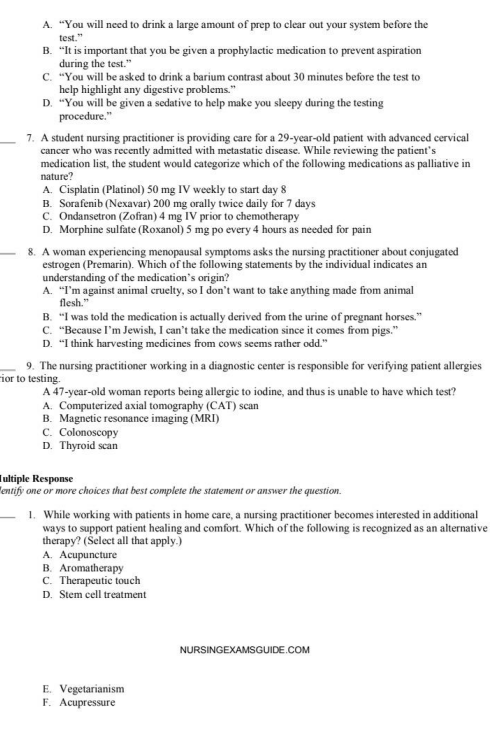
These five questions only scratch the surface. The full test bank includes hundreds of similar questions spanning every unit of the 5th edition, covering both calculations and classifications.
How to Study With This Test Bank
- Separate your calculation practice from your classification review. They test different skills, so give each its own focused study time.
- Show your work on calculation questions. Writing out each step, even during practice, builds the habit that prevents errors on exam day.
- Group medications by classification, not by brand name. Understanding how a whole drug class works helps you answer questions about unfamiliar medications in that same category.
- Read every rationale, even for questions you get right. Understanding the reasoning matters more than getting lucky on a guess.
- Revisit missed questions after a few days. Spaced repetition strengthens both math fluency and classification recall over time.
Why This Beats Generic Pharmacology Quizzes
Free pharmacology quizzes online often mix calculation methods or use inconsistent terminology that doesn’t match your course. This test bank was built specifically around Watkins and Blades’ 5th edition, so the calculation methods, classifications, and difficulty level match exactly what you’ll see on your real exams.
Format and Delivery
This test bank is delivered as a digital file. You get instant access after purchase. No shipping. No delays. Study from your laptop, tablet, or phone whenever you have a spare few minutes.
Frequently Asked Questions
Is this test bank the same as the textbook?
No. This is a companion study resource. You’ll still need Pharmacology Clear and Simple: A Guide to Medication Classifications and Dosage Calculations, 5th Edition, for full explanations, worked examples, and additional practice problems.
Does this cover dosage calculations, drug classifications, or both?
Both. The test bank reflects the textbook’s dual focus, with questions covering calculation methods as well as medication classifications, actions, and side effects.
Is this appropriate for LPN students, or only BSN students?
Both. Pharmacology fundamentals and dosage calculation skills are core to LPN, ADN, and BSN programs alike, and this test bank supports all three.
Can instructors use this to build exams?
Yes. Many instructors use test banks like this as a foundation for quizzes, dosage calculation competency exams, or unit tests.
What question formats are included?
You’ll find multiple choice, fill-in-the-blank calculation problems, true or false, and matching questions throughout the set.
Are rationales included for every question?
Yes. Each question includes an explanation, whether that’s a calculation walkthrough or a clinical rationale for a classification-based question.
Is this useful for dosage calculation competency testing?
Yes. Many nursing programs require students to pass a separate dosage calculation exam, and this test bank offers focused practice for that specific skill.
How is this different from the textbook’s built-in review questions?
Built-in review questions are usually limited in number. This test bank offers a much larger, more comprehensive question set with detailed rationales for deeper practice.
Final Thoughts
Pharmacology doesn’t have to feel like an impossible mix of memorization and math. Once classifications start making sense and calculations become second nature, this subject gets a lot more manageable. This test bank for the 5th edition of Pharmacology Clear and Simple gives you a direct way to build both of those skills before your exam. Realistic questions. Clear explanations. A study tool built around the exact way this course is structured.
Grab your copy today and study with real confidence.
Peterson S. –
Helpful rationales clarified challenging answers
Lucille Maria –
Great way to practice under test-like conditions.
Mary Kesh –
Hundreds of questions of all levels of difficulties.
Winnie M. –
Excellent resource for pharmacology exam preparation
Terence V. –
Helpful questions that improve test-taking confidence.
Alicia Silva –
Answer explanations provided useful learning points.
Caleb Martins –
Convenient practice whenever I had extra study time.
Dorcas M. –
Helped me feel better prepared for exams
fred m –
Solid resource for reviewing essential nursing topics.
Ivy N. –
Questions encouraged me to think critically.
Lucas Gabriel –
Helpful exercises for revisiting material from earlier modules.
Betty Morgot –
A convenient resource for practicing at different stages of learning.
Perpetual Gates –
Questions provide a quick check of recently studied material