Women’s health care spans a huge range of clinical topics, from routine screening to complex reproductive conditions to care across every life stage. Advanced practice providers need to move confidently through all of it, often making decisions with limited time and layered clinical information. That range is exactly what this textbook, and this test bank, are designed to prepare you for.
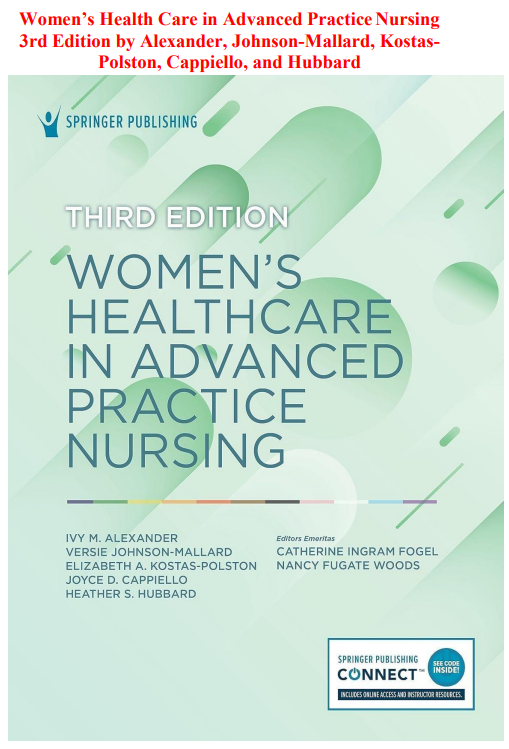
This test bank follows the 3rd edition of Women’s Health Care in Advanced Practice Nursing by Alexander, Johnson-Mallard, Kostas-Polston, Cappiello, and Hubbard, chapter by chapter. So your review sessions actually track with what your program is teaching.
Whether you’re a WHNP student, a family NP student building out women’s health competency, or a practicing advanced practice provider refreshing your knowledge, this resource sharpens the clinical reasoning this specialty demands.
What This Test Bank Covers
This textbook covers the full scope of advanced practice women’s health, and this test bank mirrors that breadth. You’ll find questions on:
- Well-woman exams and preventive screening guidelines
- Contraception counseling and management
- Menstrual disorders and abnormal uterine bleeding
- Infertility evaluation and management basics
- Sexually transmitted infections
- Pregnancy-related primary care considerations
- Menopause and perimenopausal symptom management
- Breast health and screening
- Pelvic pain and gynecologic conditions
- Sexual health and function
- Intimate partner violence and trauma-informed care
- Health disparities and care for diverse populations
If it’s a chapter in the textbook, there’s a strong chance it’s represented in this test bank.
Why This Test Bank Stands Out
1. It Follows the Textbook’s Structure
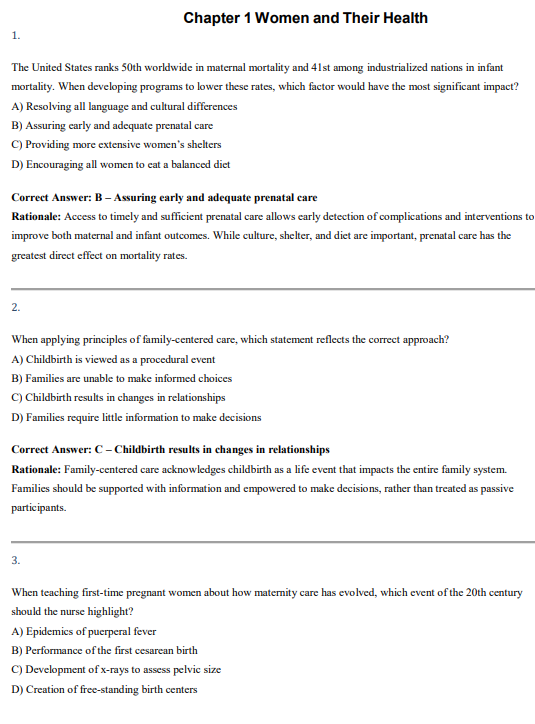
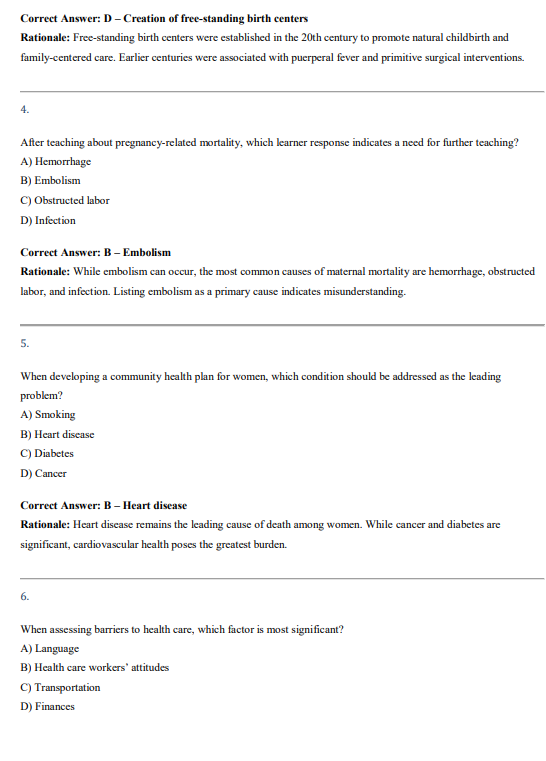
Questions are organized to match the chapters in the 3rd edition, so you move straight to the section you’re studying instead of sorting through unrelated content.
2. It’s Written for Advanced Practice Decision-Making
This isn’t a general health class test bank. Questions push toward diagnostic reasoning, treatment planning, and counseling decisions at the level expected of a nurse practitioner.
3. Every Question Includes a Rationale
An answer without an explanation doesn’t build real clinical judgment. Each question breaks down why the correct choice fits best and why the other options fall short.
4. Clear, Direct Language
Women’s health content covers a lot of nuance, from hormonal shifts to counseling considerations. This test bank keeps the wording simple so the clinical reasoning stays easy to follow.
5. Useful for Ongoing, Repeated Review
Women’s health topics benefit from repeated exposure across a semester, not a single study session. This test bank supports that kind of extended practice.
Who This Test Bank Is For
- Women’s Health Nurse Practitioner (WHNP) students
- Family NP students building women’s health competency
- DNP students focused on women’s health or primary care
- Advanced practice nurses preparing for certification exams
- Nursing faculty building quizzes or exam question pools
Sample Practice Questions
Here are five sample questions written in the same style and difficulty level as the full test bank.
Question 1: Contraception Counseling
A patient with a history of migraine with aura is requesting a contraceptive method. Which option should the nurse practitioner avoid recommending due to increased stroke risk?
A) Progestin-only pill
B) Combined oral contraceptive pill
C) Copper intrauterine device
D) Levonorgestrel intrauterine system
Correct Answer: B) Combined oral contraceptive pill
Rationale: Estrogen-containing contraceptives, including combined oral contraceptive pills, are associated with an increased stroke risk in patients who have migraine with aura. This combination is generally considered a contraindication. Progestin-only methods, the copper IUD, and the levonorgestrel IUD don’t carry that same estrogen-related stroke risk, making them safer options for this patient.
Question 2: Abnormal Uterine Bleeding
A 45-year-old patient reports heavy, irregular menstrual bleeding over the past six months. Which initial diagnostic step is most appropriate?
A) Immediate referral for hysterectomy
B) Pregnancy test and evaluation for structural or hormonal causes
C) Reassurance that this is a normal part of aging with no further workup
D) Prescribing hormonal contraception without further evaluation
Correct Answer: B) Pregnancy test and evaluation for structural or hormonal causes
Rationale: Abnormal uterine bleeding requires a systematic workup, starting with ruling out pregnancy and then evaluating for structural causes like fibroids or polyps, as well as hormonal imbalances. Jumping straight to hysterectomy is an overly aggressive first step. Dismissing the bleeding as normal aging skips necessary evaluation, and prescribing treatment without a workup risks missing an underlying condition that needs its own management.
Question 3: Menopause Management
A perimenopausal patient reports hot flashes, night sweats, and disrupted sleep with no contraindications to hormone therapy. Which counseling point is most accurate regarding hormone therapy?
A) Hormone therapy is never appropriate for symptom management
B) Hormone therapy can be an effective option when started close to menopause onset in appropriate candidates
C) Hormone therapy eliminates all future cardiovascular risk
D) Hormone therapy must be continued indefinitely once started
Correct Answer: B) Hormone therapy can be an effective option when started close to menopause onset in appropriate candidates
Rationale: Current guidance supports hormone therapy as an effective option for bothersome vasomotor symptoms in appropriate candidates, particularly when initiated close to the onset of menopause. It isn’t accurate to say hormone therapy is never appropriate, since many patients benefit from it. It doesn’t eliminate all cardiovascular risk, and it isn’t required to be continued indefinitely; duration is individualized based on ongoing risk-benefit discussions.
Question 4: Sexually Transmitted Infections
A patient tests positive for chlamydia. Which statement best reflects appropriate management?
A) Treat only the patient, since partner treatment isn’t necessary
B) Treat the patient and recommend partner notification and treatment
C) Delay treatment until symptoms develop
D) Treat only if the patient is pregnant
Correct Answer: B) Treat the patient and recommend partner notification and treatment
Rationale: Chlamydia treatment guidelines call for treating the diagnosed patient and ensuring sexual partners are notified and treated as well, to prevent reinfection and further transmission. Skipping partner treatment leaves a high risk of the patient becoming reinfected. Many chlamydia infections are asymptomatic, so waiting for symptoms delays necessary treatment. Treatment isn’t limited to pregnant patients; it applies to anyone who tests positive.
Question 5: Intimate Partner Violence
During a routine visit, a patient discloses that her partner has been physically abusive. What is the nurse practitioner’s most appropriate initial response?
A) Insist the patient leave the relationship immediately
B) Listen without judgment, assess safety, and offer resources
C) Contact the partner to discuss the allegations
D) Avoid documenting the disclosure to protect patient privacy
Correct Answer: B) Listen without judgment, assess safety, and offer resources
Rationale: A trauma-informed response starts with listening without judgment, assessing immediate safety, and connecting the patient with appropriate resources like counseling or a domestic violence hotline. Insisting the patient leave immediately can feel controlling and may not account for safety risks tied to leaving. Contacting the partner could endanger the patient further. Proper documentation is actually important for the patient’s ongoing care and safety planning, not something to avoid.
These five questions only scratch the surface. The full test bank includes hundreds of similar questions spanning every chapter of the 3rd edition.
How to Study With This Test Bank
- Match your review to your course sequence. Study topics in the order your program assigns them.
- Pay close attention to counseling-based rationales. Women’s health exams often test communication and shared decision-making, not just clinical facts.
- Practice distinguishing similar conditions. Abnormal bleeding causes, contraceptive contraindications, and STI management protocols overlap and show up often on exams.
- Revisit missed questions after a few days. Spaced repetition helps nuanced clinical guidelines stick for the long term.
- Pair this with your assigned textbook chapters. The test bank reinforces the material; it isn’t meant to replace it.
Why This Beats Generic Women’s Health Quizzes
Generic online quizzes are often written for a general audience and miss the depth advanced practice programs require. This test bank was built specifically around the 3rd edition by Alexander, Johnson-Mallard, Kostas-Polston, Cappiello, and Hubbard, so the terminology, structure, and clinical reasoning level match what your program actually expects.
Format and Delivery
This test bank is delivered as a digital file. You get instant access after purchase. No shipping. No delays. Study from your laptop, tablet, or phone whenever it’s convenient.
Frequently Asked Questions
Is this test bank the same as the textbook?
No. This is a companion study resource. You’ll still need Women’s Health Care in Advanced Practice Nursing, 3rd Edition, for full chapter content and detailed clinical guidance.
Is this appropriate for entry-level nursing students?
Not really. This test bank is written at an advanced practice level, so it’s best suited for WHNP, FNP, or DNP students rather than pre-licensure learners.
Does this cover contraception counseling in depth?
Yes. Contraceptive options, contraindications, and patient counseling scenarios are covered extensively throughout the question set.
Can faculty use this to build course exams?
Yes. Many faculty members use test banks like this as a foundation for quizzes, midterms, or final exams in advanced practice programs.
What question formats are included?
You’ll find multiple choice, true or false, matching, and short answer questions throughout the set.
Are rationales included for every answer?
Yes. Each question includes an explanation of why the correct answer fits best and why the other choices fall short.
Is this useful for WHNP certification exam prep?
Yes. The content aligns closely with concepts tested on women’s health nurse practitioner certification exams.
How is this different from the textbook’s built-in review questions?
Built-in review questions are usually limited in number. This test bank offers a much larger, more comprehensive question set with detailed rationales for deeper practice.
Final Thoughts
Women’s health care asks advanced practice providers to move across a wide range of clinical situations with confidence, from routine screening to sensitive disclosures. This test bank for the 3rd edition of Women’s Health Care in Advanced Practice Nursing gives you a direct way to build that confidence before your exam. Realistic scenarios. Honest explanations. A study tool built around the exact patient population you’ll be caring for.
Grab your copy today and prepare with real confidence.
Alan Kuqi –
Great questions that really prepare you for exams
Cayte N. –
Helpful practice questions with clear explanations
Winnie M. –
Excellent resource for nursing exam preparation.
Lucille Maria –
Really helpful for reviewing challenging nursing topics
Alicia Silva –
Great practice resource for building nursing exam confidence.
Helen Christie –
Clear format made practicing quick and simple.
Lisa Horton –
Helpful for reviewing material between classes.
Bruno Molino –
Questions provide extra opportunities to practice learned skills.
Alexander Savic –
A useful study companion for independent revision.
Danielle Kayle –
Convenient material for revisiting topics before moving forward.
Charlotte Rivera –
Practice questions help keep review sessions focused.